Ash Tree Hope & Pagans on Nature
The latest news on nature and conservation in Britain.
National news
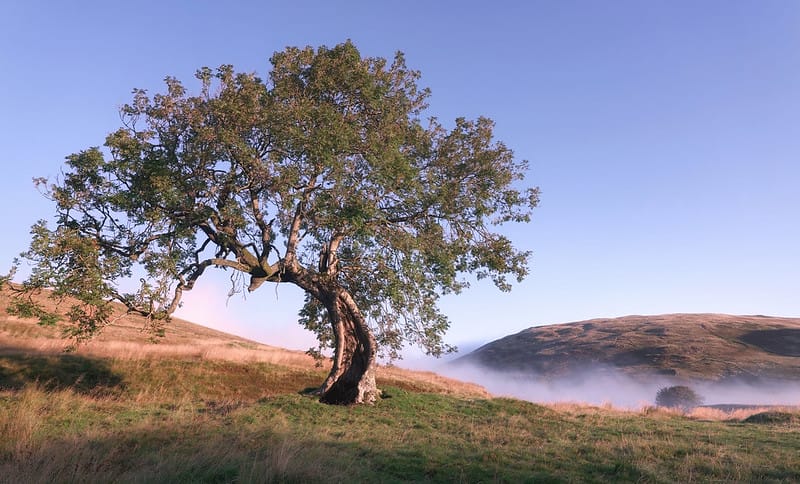
Ash | Scientists have discovered that wild populations of ash trees are developing resistance to the deadly fungus which has devastated their numbers. Ash dieback disease was first identified in the UK in 2012, where it has killed millions of trees and is expected to wipe out up to 85% of the non-resistant population. Now, a study of the species at a woodland in Surrey has revealed that the trees are evolving greater resistance thanks to their ability to produce an abundance of seedlings: an example of Darwin’s natural selection theory in action. The researchers say that the discovery underscores the importance of allowing the natural regeneration of woodlands, which enables this evolution to take place. Co-author Richard Nichols said that the ash species isn’t saved yet, but ‘it’s looking promising. We are watching evolution happen and what’s remarkable is that it’s happening so quickly, in a single generation.’ The news was widely covered by national outlets.
Hen harriers | A record number of hen harriers have been illegally killed, or disappeared in suspicious circumstances, over the last five years, with 2023 the worst recorded year for persecution, according to a report from the RSPB. Criminal activity is the main factor holding back the raptor’s recovery in the UK. The birds are targeted due to conflicts with grouse shooting; the report says that the majority of the 102 recorded incidents happened on grouse moors in the uplands of Northern England, with birds and their chicks attacked in occasionally gruesome ways. Dr James Robinson, RSPB chief operating officer, called for regulation of the grouse shooting industry. The Moorland Association, which represents moorland managers, angrily rejected the findings. The BBC and the Telegraph covered the news.
Turtle doves | A project based in Suffolk is racing to rescue England’s turtle dove population by breeding hundreds of the birds each year and releasing them in estates and farms across the country. The doves are the fastest declining bird species in the UK, with just 2,000 pairs left – a decline of 98% since the 1970s. Last year, the Turtle Dove Trust bred 800 doves in captivity, and were able to release 606 into the wild after acclimatising them in large aviaries. This year they have added some hefty names to their support list: King Charles has allowed the Trust to build an aviary on his Sandringham estate, while conservationist and financier Ben Goldsmith will also release 200 birds on his Somerset farm. The Guardian covered the story.
In other news:
- Defra has announced £500,000 of funding for UK researchers to analyse the impact of war on Ukrainian soil and farmland.
- Forestry and Land Scotland has restored 1,126 hectares of rainforest in the 2024/25 season, up from 930 hectares the previous year, reports the Herald.
- Water companies must now publish plans to reduce pollution incidents and address the use of nature-based solutions to manage wastewater, under new legal measures.
- Defra has pledged to spend £1bn upgrading the Weymouth biosecurity labs to protect Britain from disease incursions, reports the BBC.
Across the country
County Durham | Roofing work has been halted on a housing estate in County Durham, following concerns that swift nests were being blocked by plastic boards fitted to the eaves of the houses. The Bridgehill Estate, in Consett, is home to one of the largest colonies of swifts in the northeast, and it is a criminal offence to disturb them. Save Newcastle Wildlife reported the disturbance to Durham Constabulary, amid concerns that some chicks may have already been trapped in their nests. HomeGroup, which is behind the renovations, denied that any birds had been affected so far, and agreed to take the scaffolding down until September. The BBC covered the news, while the Chronicle spoke to residents about what the swifts meant to them personally.
Highlands | An innovative rewilding scheme in the Highlands has used drones to reseed a bare hillside. Forester and landowner Ed Townley trialled the use of drones at Dubh Allt, a landholding on the Moidart peninsula, last April. He used the drones to disperse a mix of native tree seeds across three hectares of degraded moorland, which had been stripped of natural woodland by historic grazing. Now, the results are in: an ecological survey revealed a seedling germination rate of 2.7%, well above the hoped-for rate of 1%, meaning the method of woodland creation is both viable and cheaper than originally anticipated. Townley said that seeding by drones could have a ‘big future’ as it occupies a ‘happy medium’ between expensive conventional planting and slow-moving natural regeneration. The Herald reported the news.
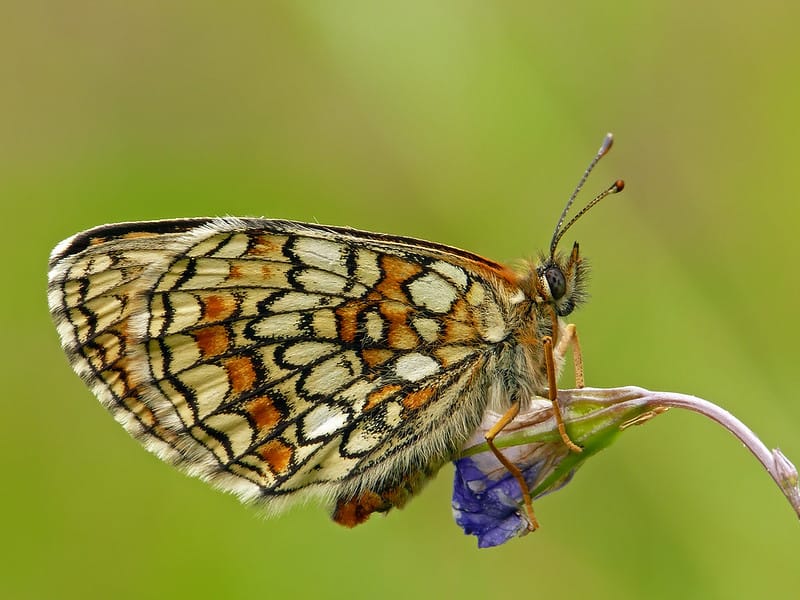
Exmoor | Against a backdrop of severe butterfly declines, one species is bucking the trend: numbers of the rare heath fritillary butterfly have surged on moorland in the English west country. This year, more than 1,000 have been counted on the National Trust’s Holnicote Estate on Exmoor and nearby land. Experts have attributed the significant rise – up from about 600 last year – to a combination of sunny spring weather and targeted habitat improvement. The National Trust and Butterfly Conservation have been attempting to create the ‘ideal’ habitat for the butterfly, including using Devon Red cattle to selectively graze land, removing bracken and cutting glades at woodland edges. The butterflies have also colonised new areas, which conservation manager Jenny Plackett said was ‘highly unusual’ due to their ‘very sedentary’ nature. The Guardian and Times covered the story.
Elsewhere:
- Norfolk Wildlife Trust has announced that ospreys have successfully bred in East Anglia for the first time in around 250 years, reports the BBC.
- A European project trialling a system of wet farming known as ‘paludiculture’ has chosen the Great Fen in Cambridgeshire as one of its four trial sites, reports the BBC.
- Natural Resources Wales has successfully prosecuted Welsh Water and fined the company £900,000 for polluting protected areas of the Gwent Levels, reports ENDS.
- Researchers from the University of Kent have planted seedlings from Devon in soils similar to those found on the moon and Mars to test whether it is possible to grow tea in space, reports the BBC.
- A study by the Environment Agency is investigating ways to facilitate the journey of juvenile salmon along the River Itchen to reach the sea, reports the Daily Echo.
- Campaigners claim that nearly 200,000 litres of sewage was dumped illegally into Lake Windermere during a single day last year, reports the Times.
- Buglife is calling for the urgent protection of Tilbery’s ashfields in Essex, where nature has recolonised the waste from the former coal-powered Tilbury Power Station.
- While surveying in Kent, a Butterfly Conservation ecologist has stumbled upon an entire colony of Dover Twist moths – a species thought to be extinct in England for 73 years.
- An area of woodland on Gower, Swansea, which was illegally felled by its owner in 2019, will now become a nature reserve after a long-running court case, reports the BBC.
- Wetland restoration by the Norfolk Wildlife Trust near Kings’ Lynn has revived a ‘ghost stream’ and boosted rare plant species.
- Researchers from Durham University have fitted 22 red deer in the west Highlands with GPS collars as part of a study into how to keep deer populations sustainable, reports the BBC.
- Cornwall Council has started work on a multi-million pound wildlife crossing, nicknamed the ‘badger bridge’, over four lanes of traffic, reports the Good News Network.
- The organisers of Glastonbury Festival have said the event will take a fallow year in 2026 to allow the farmland and surrounding environment to recover, reports the BBC.
- Vandals have illegally felled historic trees which were more than 100 years old at the Larches nature reserve in Detling, reports Kent Online.
Reports
Ocean | Protected marine sites along the Welsh coast are suffering thanks to polluted rivers, warns a report by Natural Resources Wales. The body conducted an assessment of 17 protected areas, covering 37% of the Welsh MPA network. They found that nutrient pollution – originating in agricultural run-off, slurry spills, and sewage discharges – is damaging the seabed ecosystems. WWF Cymru said the pollution is ‘suffocating our sea’, and is calling for a ‘strong recovery plan’ for ocean habitats, backed by law and funding. The report did deliver some good news for bottlenose dolphins and grey seals, with Welsh SACs considered vital in maintaining and even growing their populations. The BBC covered the research.
Landscape | Scotland’s Landscape Alliance, a coalition of more than 60 organisations, has published an updated version of Scotland’s Landscape Charter. The charter, first published in 2010, aims to promote awareness of the critical contribution of Scotland’s landscapes to everyday lives. It is based on three core principles: collaboration between sectors, dynamic management, and diversity within landscapes. The updated version has been formally endorsed by the government and NatureScot, and it has a new emphasis on sustainable land use, biodiversity enhancement, and addressing climate change. The charter is also accompanied by six case studies of best practice, including sustainable development on the Isle of Canna and the creation of multi-functional greenspace in post-industrial Glasgow. The Alliance has an introductory video here, and the Herald covered the news.
Forest | Scotland surpassed its target for creating new native woodland last year, according to figures published by Forest Research. In total, Scotland created 8,470 hectares of new forest or woodland, representing over half (54%) of all UK new woodland. Out of this, 5,300 hectares was native woodland – exceeding the government’s commitment of 4,000 hectares set out in the Programme for Government (PfG). Despite this boost, Scotland fell short of its broader targets, which included creating 10,000 hectares total under the PfG. In particular, there was a noticeable drop-off in the number of small-scale woodlands being planted by farmers or crofters, likely due to inflationary pressures that delayed or halted projects. To address this, Scottish Forestry has announced an additional £1m in grant funding specifically for woodlands under 20 hectares to help farmers resume tree-planting efforts.
Science
Capercaillie | A three-year study has revealed that humane predator management successfully doubled capercaillie brood numbers in targeted areas of the Cairngorms. Researchers from the University of St Andrews left out deer carrion at the ‘critical’ eight-week period when the endangered birds are nesting and hatching, thus diverting predators such as pine marten and badgers from the nests without harming them. Using camera traps, the researchers found that 85% of monitored capercaillie had chicks in areas with alternative food sources, compared with just 37% in ‘unfed’ control sites. As a result, the number of predicted chicks per hen rose from 0.82 without feeding to 1.90 with feeding: an increase in productivity by 130%. With only around 500 capercaillie left in the UK, the authors argue that this non-lethal intervention could provide a vital lifeline for the species. The Herald covered the study.
Water sports | Researchers from Heriot-Watt University have warned that water sports such as kayaking and paddleboarding are unknowingly disturbing whales, dolphins and seals in Scottish waters. The study used more than 400 hours of land-based observations across five marine regions – including the Moray Firth, Clyde, Forth and Tay – to analyse the interactions between vessels and marine mammals. They found that 33% of all reports which recorded a visible ‘response’ – or change in behaviour – from the species were caused by human-powered vessels such as kayaks, skiffs and windsurfers. The researchers conclude that, given the increasing popularity of these watersports, further research is needed to understand the potential conflict. The BBC covered the research.
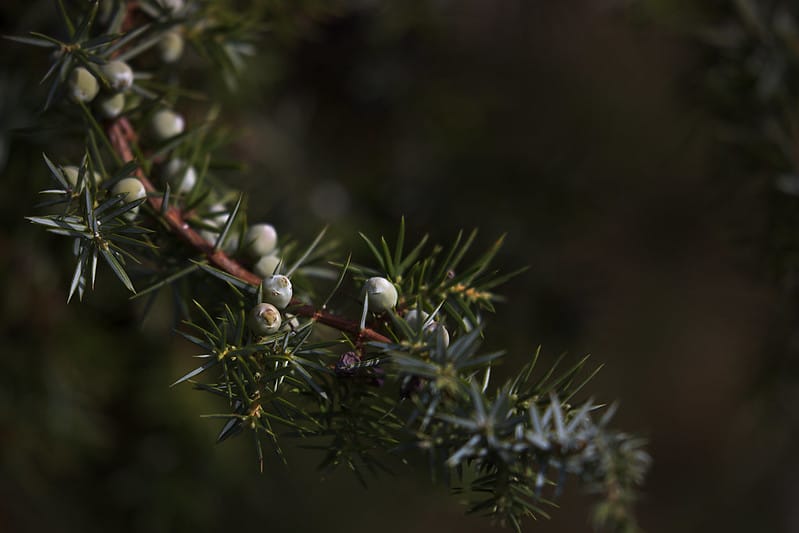
Gin | The taste of gin could be affected by climate change, according to a paper in the Journal of the Institute of Brewing. Researchers at Heriot-Watt's International Center for Brewing and Distilling investigated how weather conditions during the harvest of juniper berries – the key component of the spirit – influenced the taste. ‘For a multibillion-pound industry, which is increasingly focused on consistency and quality for its discerning consumers, this represents a risk,’ said Professor Annie Hill, co-author of the study. According to the findings, the sensory characteristics most likely to be affected are citrus, floral, sweet, peppery, woody, earthy and musty. The research could help distillers and botanical farmers to adapt by adjusting where they source, when they harvest and how they dry their juniper berries.
Driftwood
Paganism | To celebrate the Summer solstice this week, the Wildlife Trusts published a blog by Sarah Kerr, president of the Pagan Federation, on how her worldview intersects with nature and conservation. Pagans see themselves as part of an ‘interconnected web of life’, she writes, where other creatures, plants and landforms are also ‘imbued with spirit’. Conservation action flows naturally from this belief, becoming an act of devotion in itself. Similarly, a feature in Atmos looks at the resurgence of witchcraft in an increasingly atheistic society, and finds that those who practise magic are also often drawn to climate activism. ‘As a witch who believes that everything is alive with spirit in the same way that I am, why would I not protect the land that is my ally in the same way I would a person?’ says one of these modern-day witches.
Bog | In the Guardian, horticulturist and journalist Alys Fowler writes about the understated, beguiling magic of Britain’s bogs. Mountains have impressive views, forests have majesty, wildflower meadows an easy romance – but the bog ‘is quite happy to be passed over,’ she writes: ‘It will share its best secrets only with those who carefully tiptoe in and are patient enough to wait a while’. Fowler has done exactly this for her new book Peatlands, in which she delves into the mystery of this habitat, from its incredible preservation of history – ‘an archive of our past doings’ – to its critical role in long-term carbon storage and water filtration. Fowler invites readers to get to know bogs on a much more intimate level: ‘These ancient beings are much more than their brown flatness suggests from a distance,’ she argues.
Meat | Would you eat sausages if you knew they came from a lab? What about eel, or even caviar? An BBC InDepth article takes a closer look at lab-grown, or ‘cultivated’, meat products. For advocates, these could provide a healthier ‘meat’ option with less cholesterol, no animal suffering, and a clever solution to cows’ methane gas burps. Companies claim that synthetic meat could reduce greenhouse gases and agricultural pressure on land – but some claims are ‘based more on hope than hard evidence’, according to a comprehensive assessment by Oxford University. Meanwhile, farmer and author James Rebanks wrote on X that cultivated meat is ‘the least wanted technology ever’, adding that people want ‘real whole foods from real farms with healthy soil’. With products on the horizon, you can soon decide for yourself.
Further reading:
- A feature in the Times explores why ‘disco’ scallops – those caught using LED lighting – are cheaper, tastier, and more sustainable.
- A series of films made by Plymouth-based filmmaker Simon Willis showcase the landscapes of Devon and Cornwall: find out more here.
- In the Guardian, read about why gulls are encroaching on British towns – and how residents are learning to live with them.
- The BBC has an interview with 23-year-old David Maxen, who splits his time between studying at Oxford University and taking care of thousands of bees in the city centre.
- For the Times, author John Lewis-Stempel writes about how a walk through the beeches is akin to a religious experience.
- A short documentary by Aeon captures the rhythms of life for a family in a secluded mountain village in Romania, characterised by self-sufficiency and a close connection to land.
- For the Conversation, researcher Andrew Hacket-Pain explains why humans may not be the only species to mark the summer solstice.
Happy days
Kate Bush | Next month, hundreds of Kate Bush fans plan to gather for a ‘mass wuther’ – a re-enactment of the dance sequence from Bush’s Wuthering Heights video – to protest a controversial proposal for a giant wind farm on the Brontë moors, reports the Times. Taking place on 27 July, some 500 dancers, dressed in red dresses and black wigs, will gather above the village where Emily Brontë lived two centuries ago, near where a Saudi-backed company has planned to build 41 turbines. ‘This is going to be a massive industrial complex built on protected peat land,’ said co-organiser Clare Shaw. ‘Can you imagine a more novel way to send the message that this isn’t wanted than hundreds of people dancing to Wuthering Heights?’
Subscribe to our newsletter
Members receive our premium weekly digest of nature news from across Britain.
Comments
Sign in or become a Inkcap Journal member to join the conversation.
Just enter your email below to get a log in link.