Climate Targets & Truffle Dilemma
The latest news on nature and conservation in Britain.
National news
Climate | The Scottish government is abandoning its target to reduce emissions by 75% by 2030, in what has been branded an ‘acute global embarrassment’ and an ‘abject humiliation’. The climbdown follows years of failure, with eight of the last 12 annual targets having been missed. In March this year, the Climate Change Committee warned that the 2023 target had become unreachable. Instead, the government will adopt five-yearly carbon budgets, echoing the approach of Wales and England. The ultimate goal of reaching net-zero by 2045 remains unchanged. The news was widely covered, with articles in the Scotsman, the Times, the Herald and the Guardian, and an explainer from the BBC of emissions trends in Scotland, what went wrong, and the implications of the latest move.
Wye | The government has announced an action plan to stop the environmental decline of the River Wye, and protect it for future generations. The move comes after years of campaigning and legal action by environmentalists who say that pollution from agriculture – particularly chicken farms – is ‘killing’ the river. The plan includes helping farmers to plant ‘buffer strips’ between waterways and agricultural land, and £35m in funding for poultry manure combustors to stop waste entering the river catchment. The Wildlife Trusts have welcomed the plan, but said it ‘does not go nearly far enough’ toward restoring the river to its full health. As well as a more joined-up approach between England and Wales, the Trusts are calling for increased support for farmers to move away from intensive production, and a well-resourced regulator to take action against those who flout the rules. ENDS covered the news.
Music | A new initiative will see nature recognised as an official artist on major streaming platforms, including Spotify and Apple Music, meaning a share of profits from records including ‘Nature’ will be distributed to environmental causes, reports the BBC. Ellie Goulding is among those who have contributed songs to the first wave of releases, adding the calls of speckled chachalacas and Amazonian oropendolas to her song, Brightest Blue. The project is called Sounds Right, and it is the work of the Museum for the United Nations - UN Live. ‘It's a way of saying to artists, “We all use sounds like seagulls and waves and wind. Why don't we pay nature a royalty?”’ says the ambient musician, Brian Eno, who has been a key part of the initiative. BusinessGreen also covered the story. Listen to the feat. NATURE playlist here.
In other news:
- The High Court will review the UK government’s climate adaptation plan after a legal challenge brought by Friends of the Earth, a man who lost his home to coastal erosion, and a disability activist, reports ENDS.
- Conservation organisations and celebrities are urging the government to fulfil its promise to ban the sale of peat products, reports the BBC and ENDS.
- Defra has conceded a claim by campaign group Wild Justice that it unlawfully granted licences for the release of game birds in two protected areas, against the advice of Natural England, reports ENDS.
- The rural affairs secretary for Wales has said there are no plans to pause the roll-out of the controversial new subsidy scheme for farmers, reports the BBC.
- Scottish Environment Link has published its key priorities ahead of the general election, including better agricultural funding and peatland protection.
Across the country
Creagan | The discovery of a globally rare species of truffle in a spruce plantation in the West Highlands has sparked a rewilding dilemma. The plantation, near Creagan, is due to be cut down and replaced with native Atlantic rainforest, but the truffle species will disappear with the non-native Sitka spruce on which it relies. Chamonixia caespitosa has only been recorded once before in the UK, in North Wales: the species is usually found in the Alps and Scandinavia, and naturalists are confused by how it arrived in Scotland. Dr Andy Taylor, the fungal ecologist who discovered the truffle, said: ‘The real crux of it is that the fungus is incredibly rare globally, so it does raise the question: do we have some responsibility to make sure it survives because we don’t know its distribution?’ The Guardian and the Herald covered the story.
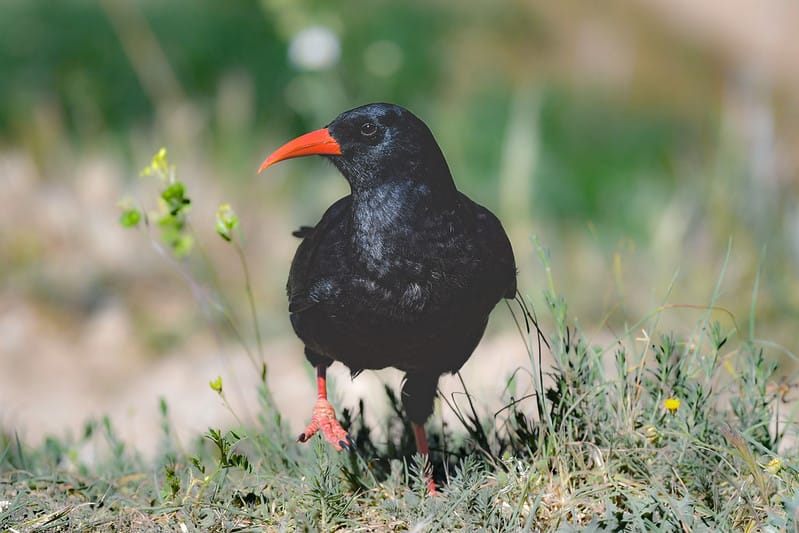
Kent | A project to reintroduce red-billed choughs in Kent has marked a ‘hugely important milestone’ with the first confirmed clutch of eggs. Proud parents Cordelia and Clive – two of the eight choughs which were released in the county last year – can be seen watching over five eggs, in a video captured on a nest camera at Wildwood Trust, just outside Canterbury. The eight birds were the first in a series of annual releases, with plans to release between 30 and 50 chough over five years. Paul Hadaway, of Kent Wildlife, said the breeding success had only been made possible through decades of chalk grassland restoration efforts, and that the eggs were a step toward ‘this flagship species becoming a common sight in Kent once more’.
Dean | Forestry England has constructed mini rope bridges in the Forest of Dean to allow dormice to travel safely between treetops. The idea came after the agency had to fell sections of the ancient woodland which were infected with ash dieback disease, leaving large gaps in the canopy. Now, two 20-metre long bridges connect the trees on either side of the gap, allowing dormice to pass between them unimpeded. Ecologist Kate Wollen explained that dormice prefer not to come down to the ground, where they feel vulnerable to predators, except for hibernation. Trail cameras will be fitted to the bridges in summer to monitor how the rodents use them, as it will be the first time Forestry England has trialled rope bridges as a conservation tool. The BBC covered the story.
Elsewhere:
- Seven ancient woodlands in Hertfordshire and Middlesex are to be restored by a new project funded by the Wildlife Trust, reports the BBC.
- The Scottish wildcat population could be bolstered using cats from northern Spain, reports the Times.
- Steve Backshall has described pollution found in the River Thames as ‘toxic’, after Bangor University analysed samples taken by the naturalist near his home.
- Natural Resources Wales and the Environment Agency are consulting on plans to tackle flooding in Powys by creating natural ‘wetland parks’, reports the Daily Post.
- The Sussex Ornithological Society is launching a survey of corn bunting to assess the local status of the red-listed species, reports BirdGuides. Meanwhile, more than 100 volunteers are helping to survey the New Forest population of woodlark.
- Cumbria Wildlife Trust is restoring a vast seagrass meadow near Barrow, at the cost of £140,000, reports the BBC.
- Gloucestershire Police are appealing for information after discovering a goshawk shot dead in the Forest of Dean, reports BirdGuides.
- Locals are demanding action after four wild goats in Llandudno – the same that achieved fame during Covid lockdowns – were killed in a road crash, reports the Shropshire Star.
- Farmers in the northeast are being offered fertiliser containing volcanic rock to boost yields and capture carbon, reports the BBC.
- A man who rescues swans in Stratford-upon-Avon has said the effects of climate change could be affecting their breeding habits, reports the BBC.
- Cardiff Council has added 33 new sites to the list of areas that will not be mowed until autumn as part of a nature-friendly scheme, reports Wales Online.
- A project in Wigan is working to boost the ‘scruffy’ habitat favoured by the willow tit, one of the most endangered small birds in the UK, reports Wigan Today.
- The unseasonably wet weather has decimated the number of snake’s-head fritillaries found during Oxford’s annual wildflower count, according to the local Wildlife Trust.
Reports
Tax | A report commissioned by REVIVE, the coalition for grouse moor reform in Scotland, investigates the potential for extending Council Tax to land holdings in Scotland. Land is the ‘greatest immovable asset and store of wealth’ in Scotland that is not currently taxed, according to the report. Various proposals have been put forward previously for a land tax, but Common Weal – the think tank behind the report – suggests that extending council tax to cover land as well as domestic buildings would be more efficient than creating a separate tax. Rural councils would benefit most from this change, with the Highland Council expected to receive around £97m per year – almost double their current projected budget shortfall.
Dams | A record number of river barriers were removed across Europe in 2023, according to a report. Behind the report is Dam Removal Europe, a coalition of seven environmental organisations including WWF and the Nature Conservancy, which aims to restore waterways to their natural state. It found that last year, 487 barriers were removed in 15 European countries – a 50% increase on the previous year – leading to the reconnection of over 4,300 kilometres of river. France led the way with 156 removals, followed by Spain, Sweden and Denmark, while the UK removed just 36. European rivers are fragmented by more than 1.2m barriers, including over 150,000 obsolete barriers which pose a danger to both people and wildlife, according to the report. The Guardian covered the news.
Birds | House sparrows have topped the charts of the RSPB’s Big Garden Birdwatch for the 21st year in a row. Some 60,000 people took part in the world’s largest wildlife garden survey this year, recording 80 species and more than 9.7 million individual birds. The ubiquitous house sparrow was followed by blue tit, starling, woodpigeon and blackbird. Gardens cover an estimated 4,330 square kilometres in the UK, representing a crucial area of habitat for wildlife, and the long-running citizen science project provides invaluable data on how common species are faring in these spaces. The Guardian and BirdGuides covered the research.
Science
Green Belt | Across England, more than 12% of land is taken up by Green Belt. These areas are a precious resource, an ecological wasteland, or an unnecessary obstacle to housing development, depending upon whom you ask. Despite the intensity of the debate, there has been little actual study of how this land contributes towards the provision of ecosystem services – until now. According to a paper published in Ecosystem Services, the Green Belt has been unfairly maligned. In fact, the authors write, these belts ‘are, in part, able to live up to their “green” name and provide notable and valued ecosystem services to urban populations which they encircle.’
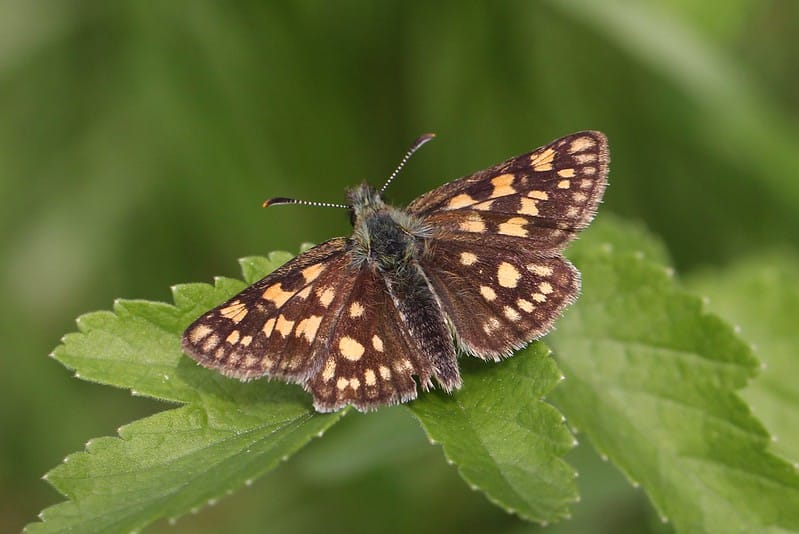
Butterflies | The chequered skipper went extinct in England in 1976, only to be reintroduced to Fineshade Wood in 2018, in a project led by Butterfly Conservation. The initial batch of 42 butterflies has now grown to 618 individuals, according to a study in Biodiversity and Conservation. To track the population, the researchers used a new technique called photographic mark-recapture. Unlike the usual mark-release-recapture method, this does not involve physically marking the butterflies – something which can influence behaviour and increase mortality risk; rather, each individual is identified from photographs that show the unique markings on their wings.
Migration | Accounting for introductions and range expansions in conservation policy could help to save globally endangered species, according to a study in Conservation Biology. Currently, the IUCN Red List only assesses the threat level to species within their native range. This has led to some counterintuitive situations, where populations of animals in novel places are not supported by conservationists, despite dwindling numbers within their historic range. In this paper, an international group of ecologists look at how policy could be adapted to deal with this modern conundrum – although, on-the-ground, the solution will likely need to be adapted to each individual situation.
Driftwood
Beef | Probably most readers of this newsletter will have already seen George Monbiot’s latest column in the Guardian – it seems as though the internet has discussed little else this week. The target of his ire is a new film called Six Inches of Soil, which he accuses of greenwashing the beef industry. Monbiot writes that there is no such thing as an environmentally friendly cattle farm. In particular, he takes aim at how the carbon sequestration potential of one farm was misrepresented in the final edit. The article has prompted intense debate and a fair amount of backlash – including from the ranks of the Guardian staff – and Monbiot has been busy fighting his corner on X. Separately, the World Resources Institute published a report on ‘better’ meat. When it comes to alternative agriculture, the trade-offs are nuanced, it concluded, with regenerative systems often proving worse for the climate.
Soundscapes | In a three-part series in the Guardian, Phoebe Weston examines the silencing of the world as biodiversity declines. In one piece, she speaks of the ‘acoustic fossils' collected by recorders over the last few decades – soundscapes that no longer exist in the modern world. In another, she profiles Bernie Krause, who has been recording the soundscapes of Sugarloaf Ridge state park, in the US, for 30 years. And finally, she visits Monks Wood in Cambridgeshire alongside Richard Broughton, an ecologist who has been studying its population of marsh tits for 22 years. That population, like so many others, is now in decline. For Broughton, the trend is personal. ‘There is an emotional toll. I can’t feel neutral about it, I can’t just treat them as datapoints,’ he says. ‘It’s my own “silent spring”.’
Forestry | BrewDog – of beer fame – recently bought an estate in Scotland, where they set about planting a ‘Lost Forest’, comprising pine, birch and other native trees. Unfortunately, the majority of them have died, according to the Parks Watch Scotland blog. The failure of the saplings was discovered by campaigner Nick Kempe through Freedom of Information requests to Scottish Forestry, whose grants had funded the planting. The story was subsequently covered by the Daily Mail. BrewDog CEO James Watt defended himself on X, blaming a hot summer and harsh winter for the deaths of the trees. But Kempe was unimpressed, responding that simply culling the deer would have enabled the forest to regenerate naturally, creating a wilder and more resilient landscape in the process.
Thanks to Jon Brady for revealing James Watt, BrewDog CEO, now admits over half his Lost Forest is dead, claiming "sustainability is hard". That is complete rubbish. All BrewDog needed to do was cull the deer and nature would have restored itself https://t.co/0h9viJX79o
— Nick Kempe (@Nick_Kempe) April 17, 2024
Further reading:
- A Scottish start-up is creating eco-friendly dyes from seaweed, reports the Scotsman.
- Efforts are afoot to rewild an old golf course in Derby – but efforts are focused underground. The Natural History Museum digs into the story.
- The humble earthworm has been crowned invertebrate of the year in the Guardian.
- We need to rewild the internet based upon the principles of ecology, according to an essay in Noema Magazine.
Happy days
Ents | An ancient and remote wych elm in Glen Affric has been selected as a guardian tree for a generation of disease-resistant saplings. A project led by the Royal Botanic Garden Edinburgh has transferred 35 young elm trees from the Garden and replanted them beneath the old elm, which is known as the Last Ent of Glen Affric, in homage to Tolkien’s fictional tree-shepherds. The young trees are the first of 200 saplings which have been cultivated specifically to resist Dutch Elm disease, and will be planted at the site over the next two years. Researchers hope that there will be cross pollination between the saplings – and maybe even with the mature elm – to boost its numbers, and ultimately help save the species from extinction. The Herald and the BBC reported the story. The Guardian also has a feature on efforts to save the English elm.
Subscribe to our newsletter
Members receive our premium weekly digest of nature news from across Britain.
Comments
Sign in or become a Inkcap Journal member to join the conversation.
Just enter your email below to get a log in link.