Drought Continues & Weed History
The latest news on nature and conservation in Britain.
National news
Drought | Hot, dry weather has continued across Britain this week, bringing more problems for people and nature. Natural Resources Wales declared drought status for North Wales, following the driest six-month period since 1976, with reports of streams drying up and fish in distress, reports the BBC and WalesOnline. In Powys, residents moved thousands of fish after noticing that Aberhafesp Brook had ‘completely gone’. A similar mission in Southampton, however, led the council to warn that the rescue efforts may be endangering great crested newts. In Sherwood Forest, the RSPB has been battling to preserve the famous Major Oak, which has already shed its leaves due to ‘severe stress’, reports Nottingham World. In the Grand Union Canal, boats were stranded after the water dried up. And in Scotland, restrictions on water use have been expanded to areas including distilleries, with rivers at ‘critically low flows’. Thatchers, the cidermakers, has started the earliest harvest in its 120-year history, with trees producing more – but smaller – apples. In CarbonBrief, a selection of scientists from the UK Centre for Ecology & Hydrology looked at whether climate change is making the UK’s droughts worse.
Landscape | Two of the government’s Landscape Recovery projects have moved from development into delivery phase – a step which the Wildlife Trusts described as ‘much awaited’ and ‘much needed’. Landscape Recovery is one of the environmental land management schemes upon which the government is depending to meet its environmental goals. Some 22 projects were chosen for initial funding, used to develop detailed, long-term plans for restoring nature across large tracts of land. The two projects to progress to the next phase are Boothby Wildland in Lincolnshire and Upper Duddon in West Cumbria. Barnaby Coupe, senior land use policy manager at the Wildlife Trusts, urged the government to approve further projects, pointing out that the rest remained ‘trapped in the development phase’ without a clear route forward.
Sewage | Almost 8,000 sewage spills took place on dry days in English rivers and seas during the first half of 2025, reports the Times. This means that those spills were potentially illegal: while water companies are allowed to discharge sewage into waterways during times of heavy rainfall, to prevent sewage backing up into homes and businesses, permits do not allow for discharges on dry days. It also means that wild swimmers – who know to avoid rivers following heavy rain – may have been unprepared for the pollution. South West Water was by far the worst offender. Separately, the Guardian reported that English water companies have spent £16.6 million fighting legal action against regulators and campaigners over environmental breaches, including sewage spills. ‘That money should be spent fixing our broken water infrastructure, not trying to deny the scale of the problem,’ said MP Helena Dollimore. This time, it was Thames Water who was the worst offender.
In other news:
- The government has succeeded in eradicating a spruce tree pest from all 13 outbreak sites across England.
- More than 400 Tesco farmers will receive additional financial incentives to support the supermarket’s environmental and animal welfare goals.
Across the country
Orkney | Following recent mass strandings across the archipelago, Orkney Islands Council is developing a Whale Stranding Protocol, thought to be the first of its kind in Scotland. Cetacean strandings have surged over the last 30 years, with scientists blaming various human factors. The protocol will establish a procedure for dealing with whales, the decision-making process, and the roles played by the various organisations involved. Mass strandings can be complex, and deciding how to deal with the carcasses – whether they are buried or left to decompose, for instance – must be guided by several factors. Hayley Green, corporate director at the council, said it was about ‘making sure that we're working in the most respectful and effective way to come up with the best solution in what can be very emotive and upsetting circumstances.’ The Herald and STV covered the news.
Gower | In 2022, a landowner in Gower was convicted of cutting down 21 acres of woodland without a licence – an act described by Natural Resources Wales as the worst case of illegal tree felling they had seen in 30 years. But the future of the damaged land now seems bright. The Gower Society bought the land and leased it to the Wildlife Trust of South and West Wales, which has now revealed plans for its restoration. Hedges will be replaced, new ponds installed, and cattle introduced for grazing. There will be new areas of grassland and woodland, and fences will be installed along the boundary to prevent other grazers from entering. ‘The aim is to repair, replace and restock with nature this part of Gower which was so brutally destroyed,’ said Glyn Morgan of the Gower Society. WalesOnline covered the news.
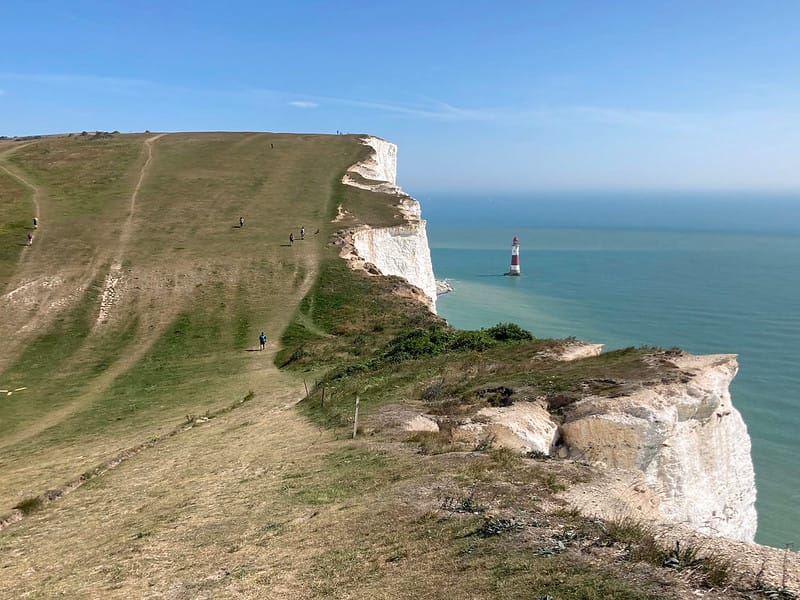
East Sussex | Sussex Wildlife Trust has launched legal action against the Marine Management Organisation, challenging its decision to allow Brighton Marina to dispose of dredged sediment in the Beachy Head West Marine Conservation Zone. The company that owns the Marina says that dredging is needed to ensure safe navigation for boats, and that the sediment is regularly sampled to check it will not damage the environment. But conservationists claim that the material is damaging the ‘sensitive chalk reef and harming its wildlife’ and filling rock pools with black, slimy sludge. The local MP, Chris Ward, supported the legal challenge: ‘It should never have come to this. Our marine environment is too precious to be treated as an afterthought,’ he said. The BBC and Oceanographic covered the story.
Elsewhere:
- Lancashire Wildlife Trust has launched a campaign to return lost insects to peat bogs across Lancashire and Greater Manchester, reports the BBC.
- Swansea Council plans to declare 16 new Local Nature Reserves, reports WalesOnline.
- A green space in Kent has been designated as a Local Wildlife Site, reports the BBC.
- Plans for two giant seaweed farms off the Cornish coast have been abandoned after the Marine Management Organisation suspended their planning applications, reports CornwallLive.
- The National Trust and Environment Agency have teamed up to reintroduce water voles to the River Wey in Surrey, reports the BBC.
- A citizen science study has revealed alarming levels of microplastic pollution in the Itchen River, reports the Daily Echo.
- In Jersey, the environment minister has proposed increasing the minimum size at which king scallops can be caught to protect future supplies, reports the BBC.
- A population of endangered white-clawed crayfish has been discovered at Cannock Chase in the Midlands, reports the BBC.
- Cumbria Wildlife Trust is assessing 2,600 Local Wildlife Sites to see how they are faring, reports the BBC.
- Charities are stepping up their efforts to prevent Coul Links – a protected coastal site in the Highlands – from being developed into a golf course.
- Sewage is being discharged from a septic tank on Coquet Island in Northumberland, which is home to rare birds, reports the BBC.
- Farmed land in West Sussex could be restored to chalk grassland, reports the BBC.
- More than 100 chough chicks have successfully fledged in Cornwall for the third successive year, reports the BBC.
- The Sycamore Gap tree was at least 100 years old when it was cut down, according to experts from Historic England.
- Suffolk County Council has finished drafting its Local Nature Recovery Strategy; it will go to the cabinet for approval next week.
- In Norfolk, a permit for a proposed megafarm for chickens has been rejected because of ammonia pollution fears, reports the BBC.
Reports
Contamination | There could be more than 45,000 contaminated sites across Wales, potentially affecting people and wildlife – but only 82 have been officially designated as such, and almost none have been inspected. This is the conclusion of research by Friends of the Earth Cymru. The charity published its overall findings, plus a breakdown for each local authority. It is now calling for a public enquiry into the scale and the impact of contaminated land. ‘Without proper inspection, these sites remain a mystery – a hidden toxic legacy from our industrial past that could still be harming communities today,’ said FOE Cymru spokesperson, Kirsty Luff. WalesOnline covered the news.
Carbon | Natural England has released an extensive, four-part report exploring how nature recovery can support carbon storage: the results of its so-called ‘Nature Net Zero’ research. The series looks at the volume of carbon stored in semi-natural habitats, the impacts of climate change on high-carbon habitats, how government targets for nature recovery might affect carbon storage, and the land use synergies and trade-offs that occur when expanding land for carbon. The report is replete with interesting statistics: it finds, for instance, that 41.5% of carbon stored in England’s priority habitats is found in the SSSI network, and that deciduous woodland contains the greatest volume of carbon, followed by blanket bog.
Badgers | The government has published a new evidence review, led by Professor Sir Charles Godfray, looking at how to tackle bovine tuberculosis – a disease spread from badgers to cattle, as well as cattle-to-cattle, and which has led to the mass slaughter of both animals. The government has pledged to eradicate the disease by 2038 and to end badger culling before 2029, with the development of a new strategy underway to achieve these goals. However, the report warns that there is only a ‘small chance’ that the government will meet the 2038 deadline ‘without a step change in the urgency with which the issue is treated and the resources devoted to eradication.’ To meet the 2029 target, Godfray stressed that there must be more emphasis on ‘non-lethal measures of protecting cattle’, including badger vaccination. The Times and the Guardian covered the story.
Science
Weeds | In 1523, a wealthy country gentleman called Sir Anthony Fitzherbert published an agricultural treatise called The Boke of Husbandry, which contained a chapter titled ‘To know diverse manner of weeds’. This was the first proper weed identification guide in England – a genre that has continued, in various forms, into the modern day. A paper in Weed Technology, by a historian and a plant scientist at Cornell University, traces this intriguing history, through early agricultural manuals to illustrated herbals. These books identified weeds because of their impacts on farm yield and their medicinal value: some of the plants are identifiable today, whereas others, such as the ‘hawdod’, are more mysterious. The paper concludes by looking at the impacts of these early English works on North American weed writing.
Ticks | The introduction of large grazers is a key feature of many rewilding projects: what impact will this have on tick-borne diseases? A study in Ticks and Tick-borne Diseases answers that question, using the New Forest as a case study. Introducing large animals to landscapes potentially means more hosts for blood-sucking ticks, suggesting that humans are more likely to become infected with Lyme disease, for example. Yet, counterintuitively, the study found that the presence of ponies and cattle reduced tick density. Grazed areas had shorter vegetation and more bare soil, meaning that ticks were less likely to survive. It is also possible that grazed areas had fewer small mammals, which also act as hosts for ticks. The exact outcome, however, varied according to the species of tick.
Boar | Numbers of wild boar in Scotland are projected to rise from 1,472 to 2,399 by 2075, and explore an additional 131km² each year – although they are still likely to avoid more urbanised areas. Well-known populations in the West Highlands and Dumfries & Galloway are predicted to expand, alongside less documented populations in Perthshire, North Stirling, Moray and Aberdeenshire. The findings were generated by a model, which considers birth and death rates, movement patterns, habitat preferences and social behaviours – although not climate or land use change. The researchers hope that it could inform measures to help people and farmers coexist with boar in the future, including compensation schemes and targeted culling. The study was published in Ecological Informatics, and was covered by the BBC and the Scotsman.
Driftwood
Oaks | The Druids Oak is an 800-year-old tree in Buckinghamshire; it has survived droughts, storms, heatwaves, and more. Now, scientists want to know if this ancient tree just got lucky, or whether there’s something in its genes that enabled its remarkable longevity. It is one of around 50 ancient oaks that will be studied as part of a project, led by the Woodland Trust, exploring the lessons that such survivors could hold for Britain’s woodlands today – for example, by helping conservationists to plant oaks with the best chances of surviving climate change in the future. ‘By exploring the genome of ancient trees, we can understand how to manage them better so that we can secure their future for generations to come,’ said Dr Emma Gilmartin of the Arboricultural Association, which is also involved in the project. The BBC covered the story.
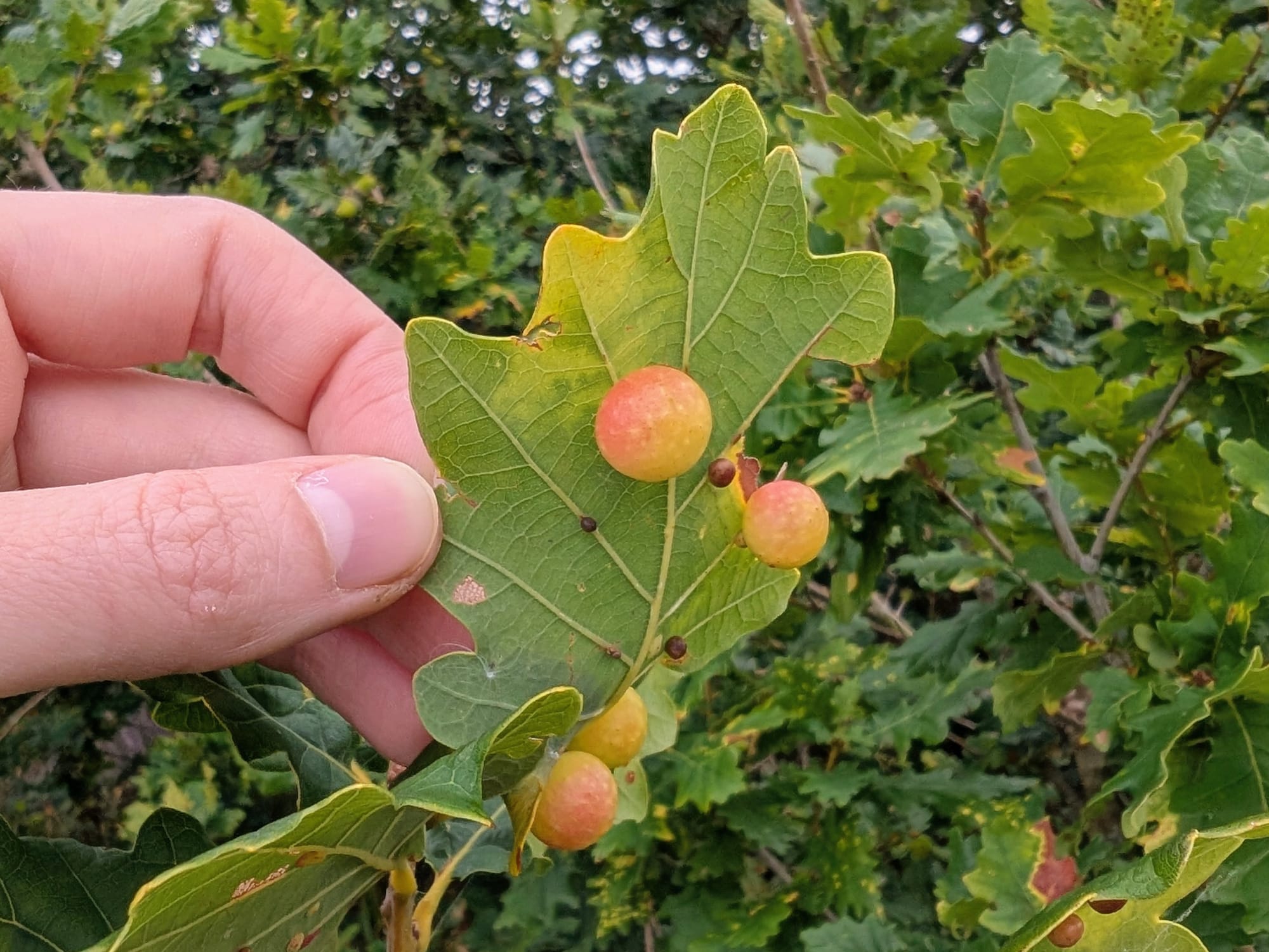
Galls | This feature in Country Life will give you a newfound appreciation for galls. Galls are growths caused by parasitic organisms, some ‘pinned to leaves like delicate jewel brooches’ and others ‘like alien invaders’, as the writer, Deborah Nicholls-Lee, puts it. She delivers a wealth of gall-related facts: that they emit a range of different smells and come in a variety of flavours, for instance. (Apparently, the gall of the apple sage is sometimes considered a delicacy when preserved in sugar.) Galls also have a fascinating cultural history, oftentimes hinted at by their names. Robin’s pincushion galls, for example, were thought to have been created by the woodland sprite Robin Goodfellow, aka Puck. In the Middle Ages, galls were even used to predict the future. And, contrary to popular belief, they are not bad news for the plant.
Fish | Angling has been in the news lately. Last week, George Monbiot penned a column in which he criticised a bluefin tuna fishing tournament: ‘the UK’s equivalent of bullfighting’. This week, PETA suggested the competition was the equivalent of ‘kicking a puppy’. In the Telegraph, however, fieldsports enthusiast Charlie Jacoby leaps to the defence – which he sums up himself as: ‘It’s a fish. Look at the benefits.’ He does not expand much on those benefits. Tim Bonner, chief executive of the Countryside Alliance, is more specific in The Critic. Anglers are effective conservationists, he writes, raising money for the Environment Agency through rod licences, and suing polluters for water pollution. He pits his argument against those arguing for river access and animal sentience. It is time the British political classes are educated, he concludes, ‘in the gentle art of angling and all the benefits that flow from it.’
Further reading:
- In the Times, botanist Leif Bersweden discusses what the ‘false autumn’ means for Britain’s trees.
- In the Guardian, Ben Martynoga writes about how regenerative farmers are focusing on soil health.
- Chris Packham wants to launch his own rewilding project, but he is struggling to sell his house, reports the Times. It’s yours for £2.4 million.
- In the Guardian, author Lucy Jones writes about the impacts of hot weather on British ecosystems.
- The Conservatives should be the party of the environment, writes Michael Gove in the Telegraph.
- Most climate and biodiversity papers are published in English – which means that a lot of knowledge is overlooked. Read more in Inside Climate News.
- An article in Country & Town House looks at Anders Povlsen’s efforts to rewild his estate in Scotland.
Happy days
Comics | Ultrawild: An Audacious Plan for Rewilding Every City on Earth is a new comic book by Steve Mushin. Its ideas probably won’t be inspiring government policy anytime soon – among its inventions are habitat-printing robot birds and compost cannons – but it may act as a good introduction to nature-related concepts for children and teenagers, according to this preview in AIPT Comics. ‘To make leaps of innovation we have to explore ideas that initially seem preposterous,’ explains Mushin. ‘And I decided to invent whatever it takes to rewild every city on earth.’
Subscribe to our newsletter
Members receive our premium weekly digest of nature news from across Britain.
Comments
Sign in or become a Inkcap Journal member to join the conversation.
Just enter your email below to get a log in link.