Environment Bill & Landscape Protection
The latest news on nature and conservation in Britain.
Welcome to Inkcap Journal, a newsletter about nature and conservation in Britain. This is the Friday digest, rounding up all the week's news, science, reports, comment and more. Sign up to receive a free one-month trial.
National news
Environment Bill | Peers demonstrated strong cross-party support for a strengthened Environment Bill this week, as the legislation went to the report stage in the House of Lords. Several key amendments were passed, including one to declare a climate and biodiversity emergency as soon as reasonably practicable. There is a run-down of the proceedings on the Lords website; Ruth Chambers, of Greener UK, also maintained a helpful live Twitter thread describing the action. ENDS Report covered the story (and, unusually, it’s free to read). It’s worth remembering that the government can use its majority in the House of Commons to overturn these amendments, so the impact of these defeats is unclear. Another positive outcome was that environment minister Lord Goldsmith announced that the government would publish a Soil Health Action Plan for England, with a consultation to be launched in spring next year.
Scotland | First Minister Nicola Sturgeon has set out the Programme for Government, outlining actions that will be taken in the coming year and beyond. It was entitled A Fairer, Greener Scotland, and contains several measures on the biodiversity and climate emergencies. In a statement to the Scottish Parliament, Sturgeon promised a biodiversity strategy by next autumn, which would be followed by a Natural Environment Bill establishing statutory targets for restoring and protecting nature. You can read the strategy in full here. ScotLINK welcomed the programme, adding that the government’s plans must nonetheless be “fully resourced” and that they “look forward to the Government’s budget for the detail on that”. In related news, the number of onshore wind turbines in Scotland is set to double to about 10,000 by the end of the decade as part of the SNP’s power-sharing deal with the Greens, reports the Times, which adds that the plans have been met with resistance from rural communities.
Badgers | In bovine TB – but not alpaca-related – news, Natural England has approved seven new sites where badgers can be culled to prevent the spread of the disease, the BBC reports, despite the government’s promise that badger culling will end in 2025. The 40 licenses will allow for between 38-83,000 badgers to be killed before this deadline. The Wildlife Trusts said it was “disappointed and saddened” by the decision. “The main cause of bovine TB is from cattle-to-cattle transmission. Badgers are not the main culprit yet thousands are killed every year,” said Jo Smith, chief executive of the Derbyshire Wildlife Trust. In its advice to Natural England, Defra writes that “the culling objective is for no more than 30% of the starting population to remain on conclusion of the cull.”
In other news:
- The government has told wastewater plants in England that they may be able to discharge effluent that has not been fully treated because of a shortage of chemicals thanks to Brexit, reports the Guardian.
- The rare angelshark has been filmed in Welsh waters for the first time, showing that they are breeding, reports the BBC.
- Activists from HS2 Rebellion are planning protests along the route of the high-speed rail line, reports the Hull Daily Mail.
- One in five ‘important’ Scottish animal and plant species face extinction, reports the Herald.
- Environment minister Rebecca Pow has been standing up for weeds, reports the Telegraph.
- Breeding seabird numbers in Scotland have almost halved since the 1980s, reports the BBC.
Across the country
Bristol | At least 70 women have “married” trees across Bristol, wearing wedding dresses from different cultures, in a ceremony carried out by a celebrant. The event took place to protest building plans for 166 apartments – including 66 social and affordable housing units – which threaten the trees. The BBC covers the story. However, not everyone supported the protest. “In recent years it seems there hasn’t been a single tree-felling in the city that hasn’t been met with some kind of outcry, regardless of how clearly the benefits outweigh the cost,” wrote Joe Dunckley in the Bristol Cable. “We must confront this shortsightedness.” Separately, councillors in Bristol have pushed through a motion that calls for a halt to proposed development on “any remaining productive wildlife-rich agricultural land”, including the city’s last working farm, reports the Bristol Post.

Wye | The Conservative representatives of Brecon and Radnorshire have criticised the Welsh government for refusing a meeting to discuss the water quality of the River Wye. According to MP Fay Jones and MS James Evans, climate change minister Julie James snubbed an event that would have brought together farmers, councillors and National Park representatives. Beneath the surface of these claims, however, lies a long-brewing fight over nitrate pollution regulations, which the government recently introduced to improve river quality, but which faced opposition from farmers – and from the two Conservative politicians in question. “Yet again, we see that the Labour Party just does not care about rural Wales,” said Evans. “We asked for this meeting to get a consensus as to how to proceed but instead the Minister fobbed us off – wrongly blaming local farmers once again.” The Brecon & Radnor Express covers the dispute.
Cairngorms | Peatland restoration work on estates across the Cairngorms National Park is being delayed by a shortage of qualified workers as demand outstrips supply. The shortfall could mean that the National Park Authority misses its own targets, according to its chief executive Grant Moir. “The team is receiving increased interest in peatland restoration from land managers across the national park and from potential private investors for carbon offsetting,” he said. “The demand for restoration work continues to outstrip the availability of peatland contractors and this is likely to limit the delivery potential for several years.” He added that it was the third year in a row that projects were unable to attract contractors to undertake the work. The Strathspey Herald covers the story.
Elsewhere:
- An acre of ancient woodland in Bracknell is being coppiced to enhance biodiversity, reports Bracknell News.
- A 32,000-bird chicken shed has been backed by councillors in Anglesey following assurances that any environmental impacts would be mitigated, reports the Daily Post.
- Giant models of poo emojis have been floated along the river in Cambridge to highlight river pollution, reports the BBC.
- A further 12 white-tailed eagles have been released on the Isle of Wight, reports the BBC.
- A crane chick has fledged in Oxfordshire for the first time in 500 years, according to the RSPB.
- Residents of Yardley are fighting against a housing development which they fear will harm onsite slow worms, reports the Birmingham Mail.
- Peterborough – regularly branded the worst place to live in the UK (sorry, Peterborough readers) – is leading the way in going green, reports the Times.
- Stable numbers of seals in the Thames suggest that the river is healthier than people might think, reports the BBC.
- Swansea councillors have approved a climate change charter – but no one has signed up to it, reports WalesOnline.
- Electric fences installed in Norfolk to protect nesting birds have been hailed as a success, reports the Guardian.
- Dorset Wildlife Trust is raising funds to launch England’s first large-scale community rewilding project.
- An eel pass has been installed in the River Hull to help the fish access feeding grounds, reports the Yorkshire Post.
Reports
Conservation | A report from Wildlife and Countryside Link looks at the government’s pledge to protect 30% of land and sea for nature by 2030, focusing in particular on how this headline idea might translate into meaningful environmental policy. The authors express concern over the government’s claims that 26% of England’s land already meets this standard – and yet, by their calculations, only 3% of land can be said to be genuinely protected for nature. The report includes a helpful summary of the different land designations across England, and how they might contribute towards the 30% target. A paper published in Global Ecology and Conservation last month came to similar conclusions: that as little as 5% of the UK may be effectively protected for nature. Currently, UK National Parks and AONBs may not meet the IUCN definition of ‘protected areas’, the paper added.
Dragonflies | More than 40% of dragonfly species have increased their distributions across Britain and Ireland since 1970, according to a report from the British Dragonfly Society, while only 11% have declined. But the news is less positive than it sounds: these trends are partly attributable to climate change, which is allowing species to push into new ranges as the temperature warms. The data also cannot show whether numbers have increased overall, and factors such as pesticides and water pollution continue to threaten the health of dragonfly populations within their existing ranges, reports the BBC. The Guardian also covers the story.
Hedgerows | CPRE released a report on the environmental and economic benefits of hedgerows. It shows that boosting hedgerows by 40% would create 25,000 jobs over the next 30 years and yield almost £4 for every £1 invested – as well as a suite of benefits for biodiversity and the climate. In the Telegraph, environment secretary George Eustice outlined how the government’s new agricultural policies will encourage hedgerow creation and maintenance. The Times and the Independent also covered the report.
Science
Conservation | A study led by scientists from the University of York and Natural England points out that counting National Parks towards the government's 30% land protection goal will have limited impact on the preservation of rare species unless their habitats are also improved. "Two-thirds of the land that has been identified as contributing to the 30% pledge has neither been selected to protect important biodiversity, nor offers specific protection to biodiversity," the authors write. They add that the highest biodiversity priority landscapes often lie outside official conservation areas. That paper was published in Communications Biology.
Herbivores | The abandonment of agricultural land across many parts of the globe is leading to an increasingly homogenous scrubby landscape – and a growing fuel load that boosts the risk and intensity of wildfires in an age of climate change. Herbivores could provide a nature-based solution to this problem, according to a study in the Journal of Applied Ecology, while also enhancing biodiversity and ecosystem services. The authors recommend either encouraging populations of native wild herbivores by, for example, reduced hunting, or introducing wild-living herbivores to the landscape.
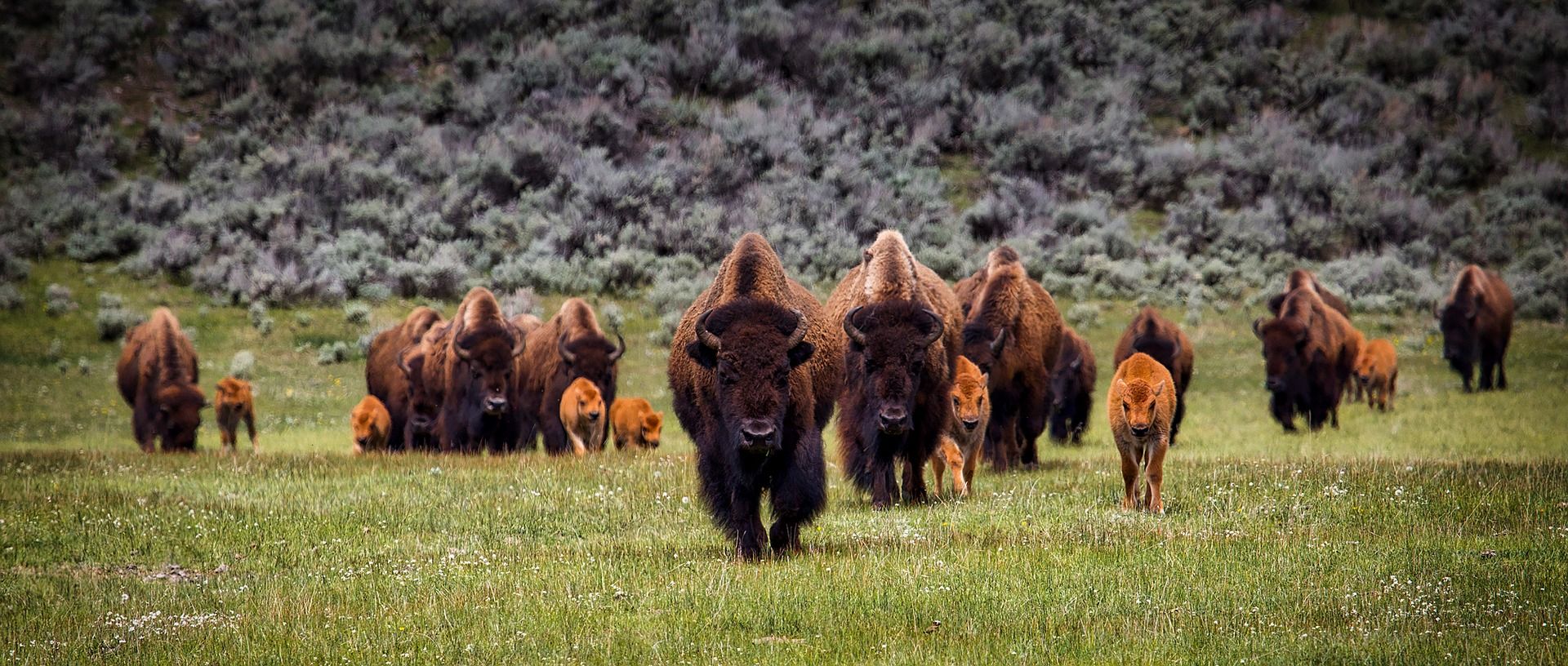
Coexistence | It is perfectly possible for humans and large mammals to co-exist in Europe’s anthropogenic landscapes, according to a study in iScience. It addresses the question of whether the distribution of large mammals is constrained by human factors or biophysical variables such as climate and terrain – and found that animals were capable of living in heavily modified landscapes. “Ultimately, the challenge of coexistence may not be about whether species are able to cope with human modification to the landscape but whether humans are willing to share their landscape and host wildlife in their backyards,” the authors conclude.
Driftwood
Rewilding | In Bella Caledonia, activist Dan Paris puts Scottish rewilding efforts into the historic context of the clearances, pointing out that many of the original Victorian landowners were attracted to the ‘wildness’ of the Highlands. The risk, he says, is that “a new generation of ‘improvements’ driven by external forces seeks to undo the ecological damage of the clearances without answering the social questions.” At the other end of the spectrum, Neil Hudson, MP for Penrith and the Border, makes the Conservative case for rewilding – “also known as wilder farming” – in Conservative Home, pointing out the economic opportunities for farmers. And the Observer profiles Julia Davies, “the millionaire rewilding the countryside, one farm at a time”.
Literature | This week brought probably the biggest moment in the literary calendar for nature writers: the announcement of the winners of the Wainwright Prize. The Lake District shepherd James Rebanks was awarded the nature writing prize for his book, English Pastoral, while Merlin Sheldrake won the prize for global conservation and climate change for Entangled Life, a book about fungi. Charlie Gilmour, whose memoir Featherhood was also shortlisted, has written a piece in the Guardian about his experiences of raising a magpie and a baby. Separately, Joanne Keys has won the Nature Writing Prize for Working Class Writers with her poem ‘Birdwatching’.
Canopy | An American scientist wants to build a treetop walkway through the Highland town of Nairn, reports the Press and Journal. Meg Lowman has spent her life building bridges through canopies in order to research these unique ecosystems. She is now spending her retirement golfing in Scotland, and has decided that such a walkway could bring a major eco-tourism boost to the local community. “We’re a bit like Aberdeen,” said Alastair Noble, chair of the Nairn Improvement Community Enterprise. “We’ve had the oil boom, but now we need to reposition ourselves and get the tourism industry here up and running, and make Nairn a nice place to live and stay.”
Further reading:
- National Geographic looks at what rising sea levels means for measuring the heights of mountains – and it all begins at a remote Cornish hut.
- Parliament has released a POSTnote – always a useful resource – on Local Nature Recovery Strategies.
- A feature in BBC Future looks at how conservationists are attempting to artificially advance the ageing process in trees to enhance biodiversity.
- The New York Times covers the conflict between farmers and conservationists over beavers in Scotland.
- National Geographic looks at the role of volunteers in maintaining England’s National Parks.
- The Financial Times looks at how restoring Scotland’s seagrass meadows could bring life back to coastal waters while tackling climate change.
Happy days
Comedy | It’s always a cheerful moment when the finalists for the Comedy Wildlife Photographer Awards are revealed. I’m a big fan of the European ground squirrel playing the pipe. The Guardian has a selection of some of the funniest ones here.
Subscribe to our newsletter
Members receive our premium weekly digest of nature news from across Britain.
Comments
Sign in or become a Inkcap Journal member to join the conversation.
Just enter your email below to get a log in link.