Leadership Contest & Anthropocene Conservation
The latest news on nature and conservation in Britain.
National news
Leadership | Campaigners have warned that the leadership race for a new Conservative prime minister could sideline crucial environmental legislation, reports the Guardian. In particular jeopardy is the environmental land management scheme. The newer bill for highly protected marine areas is also at risk, since it had only reached the consultation phase under Rebecca Pow, who has since resigned. Those remaining at Defra are working “flat out” under a skeleton structure, because “the environment cannot wait until October”, a source told the Guardian. Meanwhile, a group of 26 environment charities, including the RSPB, the Wildlife Trusts, Plantlife and the Rivers Trust, are calling on all candidates to commit to three key nature and climate pledges, including a net-zero, nature-positive economy by 2050; a stop to the decline of nature in England by 2030; and the end of environmental inequality. ENDS has compiled a table of how each Tory candidate voted on key environmental policies in the last two years, while in an opinion piece for iNews, Defra minister Zac Goldsmith argues that any candidates who neglect environmental policy will be made to pay by the public. Despite growing concerns, environment secretary George Eustice has reassured the public that the next government administration will not abandon the UK’s current net-zero target, because “it’s the law”. As proof of continued progress, he also revealed that fifty landowners have expressed interest in rewilding their land through the government’s landscape recovery scheme. The Guardian reported the story.
Contraceptives | Tests for grey squirrel contraceptives are showing promising results, according to scientists. The project, which is run by the UK Squirrel Accord, is trialling oral contraceptives as a non-lethal method to reduce populations of the invasive species. Non-native greys outcompete their smaller native relatives, and also damage UK woodlands by stripping the bark from young trees. Numbers in the UK have soared to 2.7m since their introduction in the 1870s, while there are thought to be only 160,000 red squirrels remaining. The Animal and Plant Health Agency is currently testing the use of a special feeding box, where a hazelnut paste is combined with the contraceptives; a weighted door prevents other animals gaining access, although researchers are yet to figure out how to stop red squirrels accessing the food in areas where both species are present. Scientists say the contraceptives could be ready for field trials by 2024. The BBC, the Times and the Guardian covered the research.
Soil | The NFU has published The Foundation of Food, a report outlining the organisation’s vision for good soil health. The report urges the government to invest in the UK’s soil health without delay to ensure the future of sustainable food production, as well as to meet net-zero and environmental targets. The NFU welcomes the focus on soil health in Defra’s Sustainable Farming Incentive (SFI), but says that the department must secure widespread uptake of SFI, and broaden its overall approach to soil health within ELMS. The report sets out seven key recommendations, which include increased investment in soil research, the introduction of more flexible incentives, and facilitating greater knowledge exchange and data collection. At the launch of the report, NFU vice president David Exwood said: “Farmers are already doing fantastic work in protecting and managing their soil but with the current fragility of our global food security, it has thrown food production into sharp focus. We need to look carefully at how we protect our number one asset – our soil.” Farmers Weekly, Agriland and the Shropshire Star covered the news.
In other news:
- Numbers of Scotland’s infamous biting midge will be reduced by the recent dry weather, reports the BBC.
- Pheasant shoots are being drastically scaled back across the UK after bird flu has forced bans on the importation of game birds, reports the Guardian.
- A housing association has criticised Wales’ phosphate pollution targets for worsening the lack of affordable housing, reports the BBC.
- The Scottish Environment Protection Agency has warned that the risk of water scarcity in the east of Scotland has increased, and is unlikely to improve in the next week. The BBC reported the news.
- Conservation manager Jake Fiennes has said that farmers should be financially rewarded for increasing public access to nature, reports the Guardian.
- The government has delayed deciding whether or not to build the Sizewell C nuclear power plant for a second time, reports the BBC.
- The Environment Agency’s annual assessment of England’s water and sewage companies shows their environmental performance has declined to the lowest level since the assessments started in 2011. The BBC and ENDS featured the news.
- NatureScot is launching a taskforce to respond to the avian flu outbreak, reports the BBC and the Herald.
- Dog faeces form a significant portion of the diet of red foxes in the Cairngorms pine forests, according to a study in Ecology and Evolution. The BBC and the Herald reported the research.
Across the country
Wildfire | The unusually hot weather is causing outbreaks of wildfire across the UK, particularly in “tinder-dry” woodlands. Major blazes have been tackled by firefighters in Sherwood Forest and Shirebrook woodland, with the fire services asking the public to avoid anything which might spark a fire, from disposable barbecues to discarded cigarettes. A forest fire near Ickburgh has destroyed a section of Norfolk woodland, while a fire in woodland between Oxford and Didcot disrupted train services on Wednesday morning. In Wales, a fire in Penymynydd woods is believed to have been caused by sunlight reflecting through a discarded glass bottle. The Herald reports that the risk of wildfires in the east of Scotland has been raised to “very high”, with Scots urged to take extra caution. As well as forest fires, the heat and lack of water is causing some young trees to wilt: the Oxford Mail reports that trees planted in Bicester for the Queen’s Jubilee are now dying.
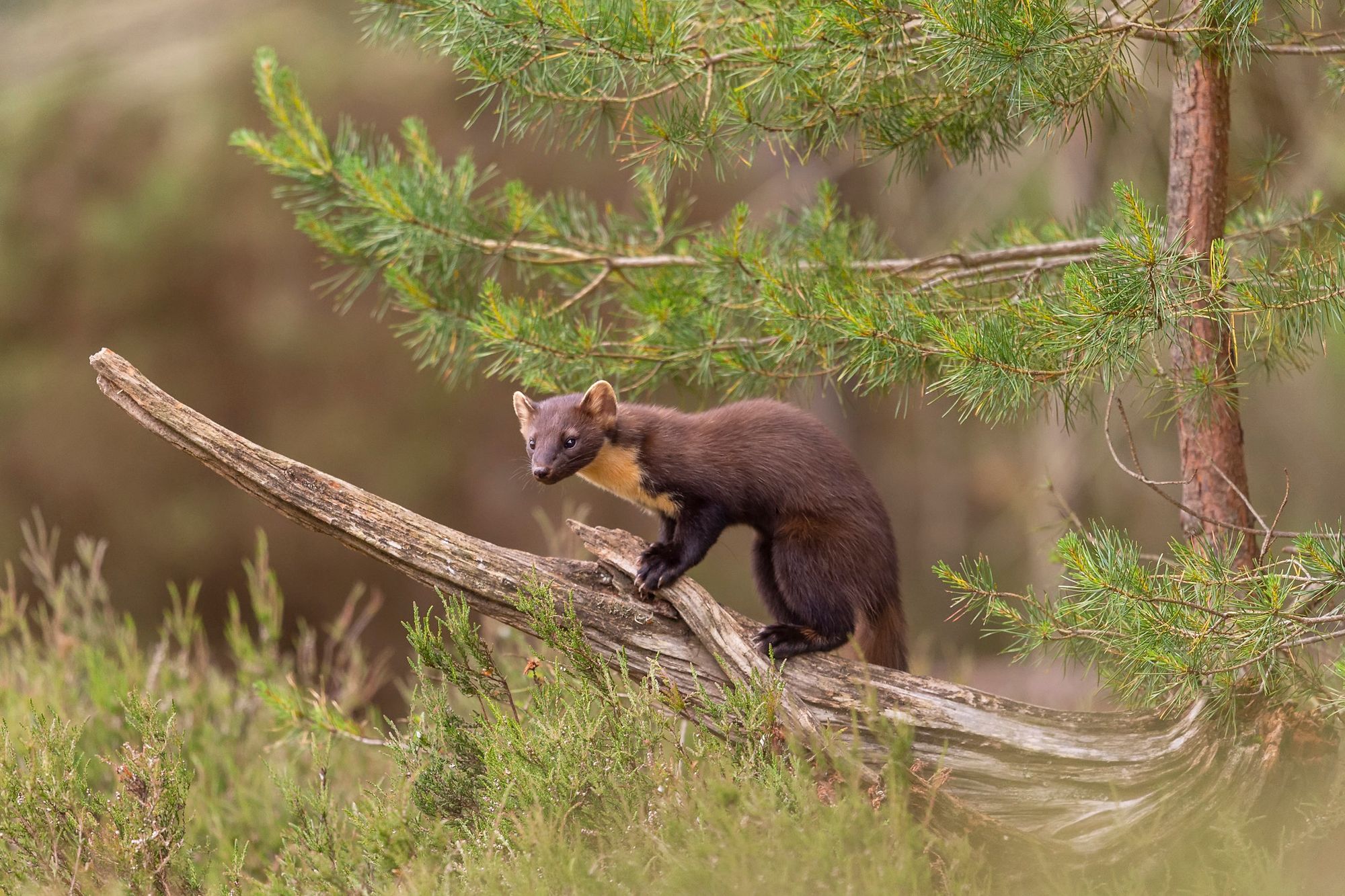
Anglesey | A team of researchers from Bangor University have spotted a pine marten on Anglesey. Pine martens are very rare in Wales, and it is the first confirmed sighting on the island in more than 30 years. The scientists were studying the habits of red squirrels in the area when they stumbled across images of the pine marten on a wildlife camera trap. Dr. Simon Valle, one of the academics involved in the research, said: “It’s encouraging to see that even on an island with such low tree cover, local forests still hold the potential for witnessing the return of a charismatic species such as the pine marten.” Wales Online reported the news.
Sutherland | A coalition of seven environmental organisations has expressed concern about the resubmission of plans to build a golf course on Coul Links in East Sutherland. The Scottish government rejected a similar proposal in 2020 due to the significant damage it would cause to the complex dune habitat. The area is particularly important for wintering and breeding birds such as Arctic terns, as well as rare plants. Bruce Wilson from the Scottish Wildlife Trust said that it was “incredibly disappointing” that the new plans, which were submitted in June 2022, do not appear to address any of the environmental concerns raised against the last proposal. BirdGuides and the Herald covered the news.
Elsewhere:
- NatureScot is urging visitors to the Isle of Mull to enjoy watching wildlife responsibly, after concerns that increasing tourist numbers are disturbing the wild animals.
- Bristol City Council has said it will not support an application for bathing water status at Conham River Park on the River Avon, due to byelaws granting the right to navigation. The Bristol Post reported their decision.
- Newcastle City Council has made a host of pledges to back up their declaration of a biodiversity emergency, including phasing out weedkiller and avoiding plastic grass, reports Chronicle Live.
- Radnorshire Wildlife Trust has launched an appeal to raise £1m to fund nature restoration on a 164-acre site at Pentwyn, an upland in the Welsh Marches.
- On the River Conwy, a project to reintroduce oysters is preparing to move thousands of juveniles to an underwater reef which will act as a nursery, reports the BBC.
- Cumbria Wildlife Trust has expressed alarm over a pollution incident in the environmentally important Cunsey Beck, which appears to have been caused by a release of untreated sewage.
- The large tortoiseshell butterfly, which has been officially “extinct” in Britain for more than 50 years, has been found breeding at Knepp Estate in West Sussex, reports the Guardian.
- Durham Wildlife Trust has launched a project to restore 13 green spaces across Sunderland’s Coalfield area, reports the Northern Echo.
- Eurasian bitterns appear to have bred in Bedfordshire for the first time, reports BirdGuides.
- In the Cairngorms, scientists have discovered two species of fungi new to the UK, and one previously unknown to science, reports the BBC and the Scotsman.
- A group of volunteers in East London are bidding to transform an industrial site into a wildlife-friendly community-owned park, complete with natural swimming ponds, reports the Evening Standard.
- The recent heatwave is threatening rare species in Norfolk rivers, an ecologist has warned. The BBC reported the story.
- The Norfolk Rivers Trust is planning to restore the ancient Hunstanton chalk stream, reports Lynn News.
- Several hundred seabirds have died from avian influenza at Scolt Head Island nature reserve in Norfolk, reports the BBC.
- Yorkshire Water will donate £400,000 to the Yorkshire Wildlife Trust after an investigation by the Environment Agency found it had polluted two watercourses.
Reports
Conservation | A report commissioned by Natural England asks how to approach biodiversity conservation at a time of rapid, human-induced environmental change. In this ‘Anthropocene’ reality, the nature of conservation must adapt: “retaining the status quo is not realistic”, the authors write, and decisions must be made in light of the changes brought about by human drivers, such as burgeoning consumption and rising human populations. The authors argue that encouraging positive change is just as legitimate as the more conventional conservation approach, which focuses on slowing biodiversity declines. The report suggests measures such as enabling species to move across landscapes and evaluating habitats based on the trajectories of ecosystem change. It also recommends asking people from a wide range of backgrounds “what they want” from their local landscapes, to develop a more inclusive approach to conservation both now and in the future.
Biodiversity | The Environment Agency has published Working with Nature, a report outlining England’s biodiversity trends and the vital role of nature in providing ecosystem services. The report reveals that a quarter of England’s mammals and a fifth of UK plants face extinction, while the populations of priority species have plunged by 61% since 1970. The report also examines the impact of land-use pressures over the last 50 years, and argues that nature-based solutions are a crucial tool for restoring biodiversity in England, as well as securing benefits such as carbon sequestration and flood protection. In a speech announcing the publication, Sir James Bevan, chief executive of the agency, warned that a “silent spring” is “closer than ever”. However, he was also determined to highlight its preventability: “Since we humans and everything we cherish depends on nature, we have the strongest possible interest in avoiding that outcome,” he said. The Times and Sky News covered the news.
Nature | IPBES, the conservation equivalent of the IPCC, has released two major reports this week examining humanity’s relationship with nature. The first, IPBES Values Assessment, is a four-year assessment by 82 leading scientists looking at how society values nature. The report concludes that a focus on economic growth and short-term profits means that the wider spiritual, cultural, and emotional benefits of nature have been ignored. It adds that policymaking generally disregards the multiple ways in which nature matters to people, and that assessing nature primarily in monetary terms is harmful to both humans and the environment. A summary for policymakers was approved by 139 governments, and the full assessment report is expected to be released ahead of the UN Convention on Biological Diversity in December. The Guardian, Nature and BirdGuides covered the report. The second IPBES report studies the sustainable use of wild species. It finds that one in five people rely on wild animals, plants and fungi for their food and livelihood, but many of these wild species are not being harvested sustainably. The report argues that the sustainability of wild species will be further threatened by climate change, and suggests actions such as tougher measures against illegal fishing and wildlife trade, better management of forests, and recognising the rights of indigenous people who take care of land and forests. The BBC covered the report, and the summary is available here. Relatedly, the chair of the Values Assessment has warned against “indiscriminate” tree planting by the Welsh government, arguing that the approach recommended by the report would “instead explore the full range of benefits associated with different afforestation policies.”
Science
Plants | Climate change is pushing Scotland’s rare arctic-alpine plants towards extinction, according to a study in Biological Conservation. Researchers from the University of Stirling found that snow pearlwort, drooping saxifrage and mountain sandwort are retreating further and further up the slopes of the Ben Lawers mountain range in the southern Highlands, in search of cooler conditions. But the authors of the study warn that the plants may soon run out of higher ground, in what they call the “elevator to extinction”. In particular, snow pearlwort – which is only found in one place in Britain – has declined by 66% since the mid-1990s. Drooping saxifrage and mountain sandwort have both declined by more than 50% in the last three decades, with the former only found in the top 50 metres of Ben Lawers. The BBC, the Herald, the Independent, the National, and the Daily Mail all covered the research.
Botany | A study in Ecology and Evolution has found that people are becoming increasingly disconnected from the botanical world. Researchers argue that this is a result of limited plant content – especially identification – in curricula across schools and universities, which in turn leads to fewer plant scientists. The authors term this self-accelerating cycle “the extinction of botanical education”. This lack of knowledge comes at a time when understanding flora and ecology is more crucial than ever: the study highlights that a lack of plant species literacy is resulting in detrimental environmental projects, from ill-advised tree planting to the spread of invasive species. The Times covered the research.
Mating | Animals are more likely to mate in warmer temperatures, meaning that climate change could have some benefits for animal reproduction, according to a study in the Journal of Animal Ecology. Researchers from the University of Aberdeen used data from 53 studies conducted across the globe to analyse the effects of warmer temperatures on the mating behaviours of 22 species, ranging across birds, butterflies, geckos, frogs, arachnids and marine creatures. While previous studies have tended to focus on one species, the breadth of this study allowed researchers to detect common patterns, and make predictions of how populations might respond to climate change more generally.
Driftwood
Darwin | Two of Charles Darwin’s original notebooks will go on public display at Cambridge University Library after they went missing over 20 years ago, reports the BBC. The notebooks were returned anonymously to the library in April, after disappearing in 2000 from a studio where they were being photographed. They include Darwin’s famous Tree of Life sketch, illustrating the evolutionary relationship between species, and are worth millions. The notebooks were dropped off at the library in a pink gift bag, accompanied by a note which read, “Librarian, Happy Easter X.” There is no CCTV in the area of the library where the notebooks were mysteriously returned, and the Cambridge Constabulary has filed the investigation pending any new evidence.
Wimbledon | Have you ever wondered how the tennis courts at Wimbledon stay immaculately clean? It is in large part thanks to Rufus, a 15-year-old Harris’s hawk who is employed to chase away the unwanted pigeons and gulls that might interrupt play or foul the spectators. His trainer, Wayne Davis, has four birds in total – two hawks, a peregrine falcon and a prairie falcon – who are employed throughout the year at various events, from Lord’s cricket ground to British airports and even the Queen’s Jubilee celebrations. Davis calls the hawk solution “the natural way to do it”, but the increasing use of drones and ultrasonic bird repellers to do the same job could mean that the days of professional falconers are numbered. The Guardian featured the story.
Meadows | A feature in the Financial Times follows the restoration of a meadow in the city centre of Oxford. Since 2020, the meadow, which is owned by Christ Church, has been the site of a project aiming to expand its range of plants and wildlife. The transformation began after Catriona Bass, a writer and environmentalist, contacted the head gardener at the college, offering him seeds from her floodplain meadow bordering the Thames. Floodplain meadows are an ancient habitat diverse in both history and botanical biodiversity. Once highly valued for their rich grazing, the worth of floodplain meadows declined with the introduction of artificial fertilisers, and consequently many were ploughed. Now, Bass is part of a scheme known as the Thames Valley Wildflower Meadow Restoration Project, which aims to connect meadows in the region. Meanwhile in Cambridge, the two Shire horses which were used to mow the wildflower meadow at King’s College will be back in August. The Cambridge Independent has a feature with King’s head gardener, Steven Coghill, about how the meadow is seeded.
Further reading:
- An article in the Times looks at the increasing pressure farmers face as the cost of agricultural land is pushed up by its new value for tree-planting and carbon offsetting.
- A feature in Nation Cymru lists their top ten animal names in the Welsh language, and how they translate.
- A blog by the British Trust for Ornithology explains how the organisation has been tackling the current outbreak of avian influenza.
- The Telegraph suggests that the next frontier for rewilding could be somewhere unexpected: none other than Britain’s favourite pub gardens.
- A piece in Carbon Brief draws together the key themes and ideas from the Nature-based Solutions Conference in Oxford.
- Discover Wildlife, from the BBC Wildlife Magazine, has a feature on city farms, and why these “green oases” are critical to biodiversity and conservation in Britain.
- In the Sunday Times, author Stephen McGuinty takes a look at three new Scottish books exploring our relationship with the natural world.
- A report by the Moors for the Future Partnership has estimated that a wildfire in 2019 on moorland in the Southern Pennines released the amount of carbon equivalent to the annual footprint of around 4,000 people.
- A photo essay in the Guardian features Scotland’s “strong-willed” and “fiercely independent” Mountain Path Team, who maintain paths for the National Trust for Scotland.
- In the Strathspey Herald, Peter Cairns, the executive director of rewilding charity Scotland: The Big Picture, argues that pine martens are not to blame for the capercaillie’s threat of extinction.
Happy days
Games | If you can’t escape into nature right now, maybe you can bring it to your tabletop instead. A fun feature in Polygon rounds up five nature-themed board games. They range from (US) national park exploration to “root”-based wilderness battles. In particular, Photosynthesis – bringing alive plants’ struggles for resources – sounds like a great choice. Although strictly a card game rather than a board game, we would add the beautiful Lost Spells to the list. It is based on the book by author Robert Macfarlane and illustrator Jackie Morris, and features a range of British wildlife in stunning illustrations.
Subscribe to our newsletter
Members receive our premium weekly digest of nature news from across Britain.
Comments
Sign in or become a Inkcap Journal member to join the conversation.
Just enter your email below to get a log in link.