Scottish Farming & Woodland Dens
The latest news on nature and conservation in Britain.
Welcome to Inkcap Journal, a newsletter about nature and conservation in Britain. This is the Friday digest, rounding up all the week's news, science, reports, comment and more.
National news
Farming | In response to the crisis in Ukraine – a country which produces 19% of the EU’s wheat imports – the National Farmers’ Union of Scotland has called on the government to impose a moratorium on support schemes for ecological focus areas, saying that this land should instead be used for food production. Many criticised what they saw as an opportunistic attack on biodiversity. Howe Mill, a farm based in Aberdeenshire, tweeted that they were “frankly appalled”, and pointed out that the plan wouldn’t address food security issues as the majority of crops grown in Scotland are destined for alcohol or animal feed. In any case, NFU Scotland may face a losing battle; just last week, the Scottish government released its own plan for supporting sustainable and regenerative farming, a plan that was deemed “ambitious and necessary” by conservation groups.
Tidal energy | A new commission will look again at the possibility of building a barrage or tidal lagoon in the Severn Estuary to generate renewable energy from the tides. The estuary has the second largest tidal range in the world, and extensive feasibility work was conducted for earlier schemes. Some calculations estimate that it could generate 7% of the UK’s total energy needs. However, no schemes were taken forward amid opposition on the grounds of costs and impacts on bird life. The new commission will have an open remit to explore a range of options, including current technology, most appropriate locations and how to minimise environmental impacts. Wales Online and the Bristol Post covered the news.
Golf | Environmentalists often criticise golfers for taking up too much land and using it in a way that is detrimental to water and the climate. The Welsh government is attempting to turn that around: this week, it granted golf clubs more than £100,000 to undertake new sustainability initiatives. Clubs can receive up to £5,000 each to foster nature, strengthen communities, reduce emissions and increase carbon storage, reports The Golf Business. “Golf recognises that it has responsibility for the sensitive management of critical natural resources and stewardship of ecological hot spots and fantastic green spaces,” said Dawn Bowden, deputy minister for sport, pointing out that there were two major golfing competitions in Wales in the next few years.

In other news:
- Campaigners are frustrated by government delays in deciding whether to back a new GCSE qualification in Natural History, reports i news.
- Conservative MP Chris Grayling has introduced a bill to the House of Commons to ban bottom trawling in marine protected areas, reports ENDS.
- The government has given permission for sugar beet farmers to use a banned pesticide on an area of farmland more than twice the size of Birmingham, reports the Times.
- Scotland’s fire chiefs have warned of “extreme” wildfires across the north, reports the Press and Journal.
- The golden eagle population in southern Scotland is the highest it has been since the early nineteenth century, reports BirdGuides.
Across the country
Trossachs | A herd of ‘conservation cattle’ are to be given new pastures at the heart of a restoration project in the Trossachs, the Woodland Trust has announced. The Trust has purchased an additional 77 hectares of land at Portnellan on its Glen Finglas estate, which will provide a new home for its prize-winning herd of Luing cattle, whose grazing helps to preserve rare woodland habitats across the area. The land where the cattle used to graze will be planted with 60 hectares of native woodland. Some of the pasture at Portnellan is old species-rich grassland, which requires cutting and grazing to preserve its rich biodiversity. The Scotsman covered the news.
Shropshire | Roads are being closed overnight in and around Ellesmere to help toads cross the tarmac in safety, reports the Shropshire Star. Having hibernated over winter, the toads are now beginning to make a mass migration back to their breeding ponds to spawn, often moving after dark. Volunteers have been helping to carry the amphibians over lanes for the past few seasons, but this year Shropshire Council has agreed to close short sections of road overnight until the end of April, and has provided signage to warn drivers. As well as toads, volunteers have also found frogs and newts, including protected great crested newts, in the last few days. If you’re in the area, the Ellesmere Toad Patrol is looking for more volunteers.
Cornwall | Natural England has been hosting Green Social Prescribing events at Goss Moor National Nature Reserve in Cornwall, introducing attendees to the herd of 26 wild Dartmoor and Shetland ponies in an attempt to boost mental wellbeing. Participants are either referred by a link worker or self-referred, and find the ponies using a tracking app. The walks are part of a long-term plan to recruit pony checking volunteers. "Green Social Prescribing events like this are wonderful for connecting people with nature, which is great for mental health and wellbeing," said Janine Sargent, the Natural England warden who ran the events.
Elsewhere:
- Public consultations are being carried out into plans for a release of beavers in the Lake District, according to ENDS.
- More than 7,000 individual shrubs and 2,000 metres of hedgerow have been planted to combat climate change in Essex, reports the Environment Agency.
- A farming couple in Wensleydale has produced ‘carbon neutral beef’, according to the Northern Echo.
- An oil pollution incident on the River Cefni on Anglesey is being investigated by Natural Resources Wales, reports the BBC.
- The shiny walls of the new police headquarters in Dorset could pose a lethal threat to birds, reports BirdGuides.
- Cutacre Nature Reserve on the border of Wigan and Salford has been transformed to improve wildlife, reports the BBC.
- Woodland in Stirlingshire has gone on the market and could be sold for carbon offsetting, according to the Herald.
- People in Dumfries and Galloway are being denied access to cheap firewood in publicly-owned forests due to staff shortages at Forestry and Land Scotland, reports the Daily Record.
- Plans to transform Manchester’s historic landmark Castlefield Viaduct into an urban sky park are underway, reports the North Wales Chronicle.
- The Countryside Alliance has accused Natural Resources Wales of “misleading the public” following its purchase of agricultural land in the Tywi valley, reports Farming UK.
- Natural England and the Environment Agency have launched joint legal action against a landowner who inflicted significant ecological damage to the banks of the River Lugg.
- Instead of No Mow May, Plymouth City Council is now supporting "low mow May", reports the Plymouth Herald.
Reports
Carbon | A report by the Energy Transitions Commission, an international think-tank, finds that natural and technological solutions must be used in tandem to tackle climate change and keep the planet from warming above 1.5C. The report outlines how optimum levels of carbon dioxide removal could be achieved by a combination of natural climate solutions (such as reforestation and improved soil management), engineered solutions (like direct air capture of emissions), and hybrid solutions (such as bioenergy plus carbon capture and storage). It finds that no single method can be deployed at the scale needed to deliver the removals required, so a portfolio approach is needed, with solutions playing complementary roles. It also warns that a major increase in investment is needed to get projects running as quickly as possible. The Scotsman covered the findings.
Tree planting | Defra’s tree-planting scheme is failing to take root, according to a report published by the National Audit Office. The report states that although Defra has worked “fast and in difficult circumstances'' to launch new tree-planting schemes, it “did not give enough consideration to whether its planting target is realistic, and looks set to fall short of what it set out to achieve in 2021-22”. At no point in the last 50 years has the annual rate of tree-planting reached 7,500ha – the department’s target by 2025 – and it has only risen above 6,000ha in three of the last 50 years. Environment secretary George Eustice responded: “We are under no illusion that there is more to do. That is why we will treble the number of trees planted rates by the end of this Parliament, backed up by over £500m.” The Times and the Telegraph covered the report.
Waterbirds | Scotland’s wintering waterbirds are facing mixed fortunes, according to NatureScot’s latest biodiversity indicator. The research reveals that the number of wintering waterbirds has continued to decline overall in Scotland, but some species have coped better than others. In particular, wader species are struggling, but goose populations are rising and there have been small increases in populations of ducks and swans. Scotland’s coasts and waters are of particular significance for waterbirds, many of which are long-distance migrants. NatureScot’s biodiversity indicator tracks populations of 41 species of wintering waterbirds using data gathered by volunteers in the Wetland Bird Survey; the latest data is for the 2019/20 season.
Science
Seabirds | Research and conservation action must be better connected in order to protect seabird species from climate change, according to a study led by the Zoological Society of London. The authors of the study sent a series of surveys to more than 180 seabird conservation practitioners across Western Europe, and used the results to identify major knowledge gaps. The results showed that many of the identified threats have not led to clear conservation actions, and that almost a third of possible interventions are linked to conflicting evidence or a lack of information. Lead author Henry Hakkinen said: “There is a real opportunity here to identify missing information and marry existing research on the risks of climate change with effective conservation and wildlife management.”
Weeds | Are weeds starting to sprout in your garden? This study shows why gardeners and farmers should think twice before getting rid of unwanted plants. In a field study, researchers from the University of Sussex compared the biodiversity of species legally deemed as ‘injurious’ by the 1959 Weeds Act (ragwort, thistle and dock species), with Defra-recommended plants such as red clover and wild marjoram. They found that the abundance and diversity of pollinators visiting the weed species averaged twice that of the recommended plants. The researchers conclude that weeds have a clearly underappreciated value for biodiversity, and that reconciling the conflict between agricultural production and these native species should be a renewed priority for land managers, researchers and policymakers. The Telegraph and Daily Mail covered the research.
Housing | The government’s plan to build 300,000 new homes per year will consume England’s entire carbon budget for 1.5C by 2050, according to the preprint of a new paper led by ecological economist Sophus zu Ermgassen. It could also be damaging to the country’s biodiversity, given uncertainties around the successful delivery of the Biodiversity Net Gain policy. The paper concludes that, while other strategies for meeting society’s housing demands are theoretically possible, they face a challenging political economy: options include disincentivising overconsumption of floor space and retrofitting. Ermgassen tweeted a lengthy thread explaining the findings in more detail.
Driftwood
Dens | Who doesn’t love a woodland den? Photography magazine Feature Shoot has published a photo story on the architectural beauty of these ephemeral structures, featuring a series of images taken by Marcus Peel. The majority of the pictures were taken in Richmond Park in London, with a few near Farnham in Surrey. As well as the physical construction of the dens, Peels says: “I’m also interested in how the landscape changes depending on the location, revealing a bit about its identity from the flora.” I can imagine some of these selling for a few hundred thousand on the London property market.
Music | The National interviews Tom Jenkins, a musician and full-time sheep farmer based near Pontypridd. It’s worth reading this for the wonderful photographs by local artist Jon Pountney alone, but it’s also a wide-ranging discussion covering carbon offsetting, rewilding and local food systems. "You’re keepers of the ground, a place of belonging,” says Jenkins. "How can you not be inspired, especially with a day like today?” In other Welsh conservation music news, Coldplay has linked up with Swansea-based Project Seagrass to support their efforts to restore these underwater meadows. Any Coldplay-related seagrass puns in the comments, please.
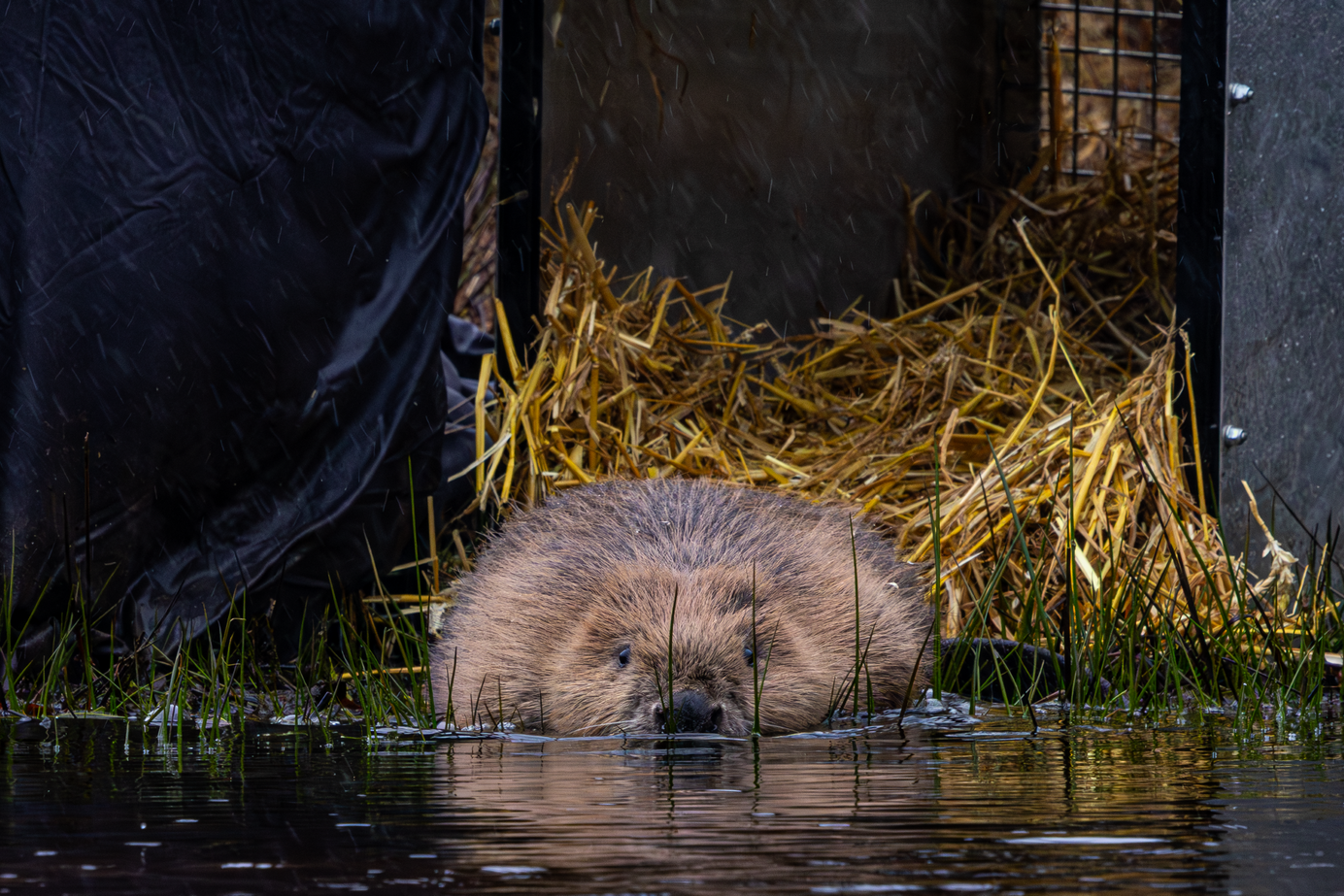
Beavers | Tom Bowser is the owner of Argaty farm in Scotland, which recently accepted the country’s first translocated beavers from another site. In the Scotsman, he takes aim at the government’s confused attitude towards the animal, which only returned in the early 2000s after being hunted to extinction around five hundred years ago – holding a position where beavers were “simultaneously protected and somehow not-protected”. Though the future direction is now clearer than it was, progress on the ground when it comes to beaver translocation is still “anything but swift”, he writes.
Further reading:
- Wild Fell by Lee Schofield, who wrote the most recent Inkcap Journal feature, has received a positive review in the Guardian.
- WalesOnline interviews George Monbiot, where he expands upon his previously stated opinion that the Cambrian Mountains contain a “terrestrial dead zone”.
- Countryfile has produced a list of the best British rural romantic films. It is almost exclusively period dramas.
- The Guardian explores the controversy surrounding BrewDog’s plans to plant a huge forest in Scotland.
- Rewilding will increase the risk of malaria outbreaks in England, according to an opinion article in Farmers Weekly.
- A glut of wool could be used to help rewet peatlands, creating a sustainable use for the material, reports the Herald.
- The Bristol Cable looks at the difficulties for disabled people in accessing green spaces.
- The Guardian looks at the potential for mussel farming to restore the UK’s damaged coastline.
Happy days
Botany | For International Women’s Day, the Natural History Museum has written about the work of Grace Mary Crowfoot, a botanist, archaeologist and advocate for women’s rights. Born in 1879, Crowfoot was a pioneer in textile archaeology, using ancient fabrics to learn more about historic people. While travelling abroad, she would also study and draw the local plants, taking specimens to study later – some of her herbarium sheets have made their way into the museum’s collections. She was also a passionate campaigner against female genital mutilation. Read more about her unconventional and inspiring life here.
Subscribe to our newsletter
Members receive our premium weekly digest of nature news from across Britain.
Comments
Sign in or become a Inkcap Journal member to join the conversation.
Just enter your email below to get a log in link.