Wild Bird Decline & Vanishing Scents
The latest news on nature and conservation in Britain.
National news
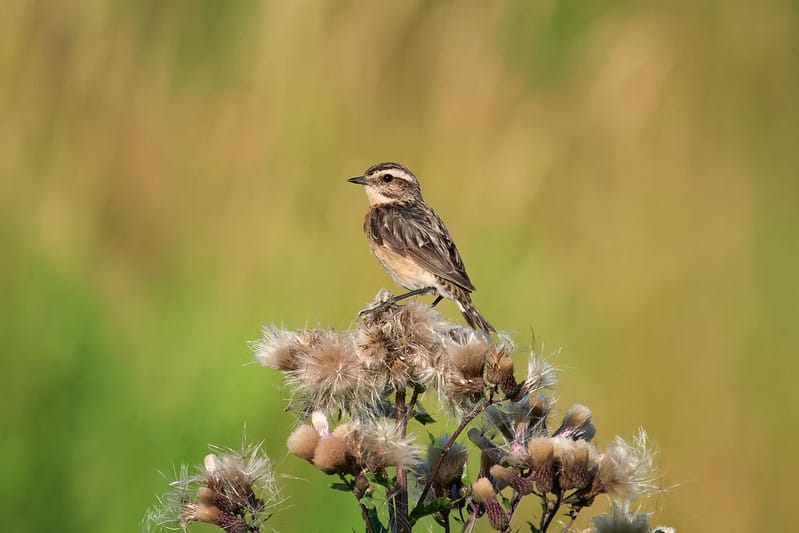
Birds | The decline of wild birds in the UK is accelerating, according to statistics published by Defra. Bird populations have been diminishing since data collection began in the 1970s, and the report found that this trend has continued in the last five years: between 2019 and 2024, on average all species declined by 4% in the UK and 7% in England. In particular, seabird numbers have been hit hard by avian influenza, while some species of farmland birds are in ‘dramatic freefall’ due to intensive agriculture. Upland birds are also in strong decline. In one piece of good news, the data shows that woodland bird populations are beginning to stabilise as more habitat is restored. The authors stress the need for widespread support and adoption of wildlife-friendly farming practices if more species are to recover. The Guardian and Telegraph reported the news, with further commentary in the Telegraph.
Oceans | A global agreement to protect two-thirds of the world’s oceans is set to become international law after it received its 60th ratification last Friday. The High Seas Treaty, which the UK helped shape over more than a decade of negotiations, will pave the way for international waters to be placed into marine protected areas. Environmentalists have hailed the agreement as a ‘monumental achievement’. The BBC and Oceanographic covered the story. In less positive news, an annual assessment of planetary health boundaries has found that ocean acidity has crossed a critical threshold for marine life. Acidity affects everything from the ability of molluscs to form their shells to the capacity of oceans to absorb heat and carbon. It is the seventh of nine planetary health boundaries to be transgressed, primarily due to the burning of fossil fuels. The Guardian reported the news. Meanwhile, the Office for Environmental Protection has found ‘possible serious failures’ in Defra’s compliance with marine targets, reports ENDS. The RSPB responded here.
Labour | Conservationists have warned the government that watering down environmental protections at the upcoming Labour Conference would be a ‘colossal mistake’. The party’s annual conference is this weekend, and green organisations are concerned that the recent emphasis on building will spell bad news for nature protection. The Wildlife Trusts issued a statement that cutting the budget would harm wildlife and the public’s enjoyment of the natural world. Meanwhile, the Times reported that the government is considering plans to weaken a law protecting national parks. The change would make it easier for building projects to be approved, even if they are not in line with the conservation goals of the park. Rose O’Neill of the Campaign for National Parks said the change would be ‘absolutely devastating’ for the landscapes. ENDS covered the news.
In other news:
- Energy secretary Ed Miliband is considering loosening the government’s stance on oil and gas exploration in the North Sea, reports the Times and Telegraph.
- Wildlife Trusts Wales and RSPB Cymru are calling on Senedd members to vote in support of introducing swift bricks to all new buildings in Wales.
- Growers are predicting one of the best apple harvests in years, reports the Times, while oaks and beech trees are also currently having a bumper mast year.
- The UK’s climate aid spending on nature reached record levels of nearly £800m last year, largely due to controversial carbon offsetting schemes, reports Carbon Brief.
- Experts advised the government to limit the cod caught next year to 11 tonnes: enough for one fish supper for every 1,200 people in Britain, reports the Times.
- The Scottish Fire and Rescue Service has issued an ‘extreme’ wildlife warning in what is the first September alert since 2020, reports the Scotsman and STV.
- Keir Starmer has no plans to attend the COP30 summit in Brazil in November, despite criticising Rishi Sunak’s absence a few years ago, reports the Financial Times.
- The Environment Agency is struggling to monitor serious pollution incidents, according to documents seen by the BBC.
Across the country
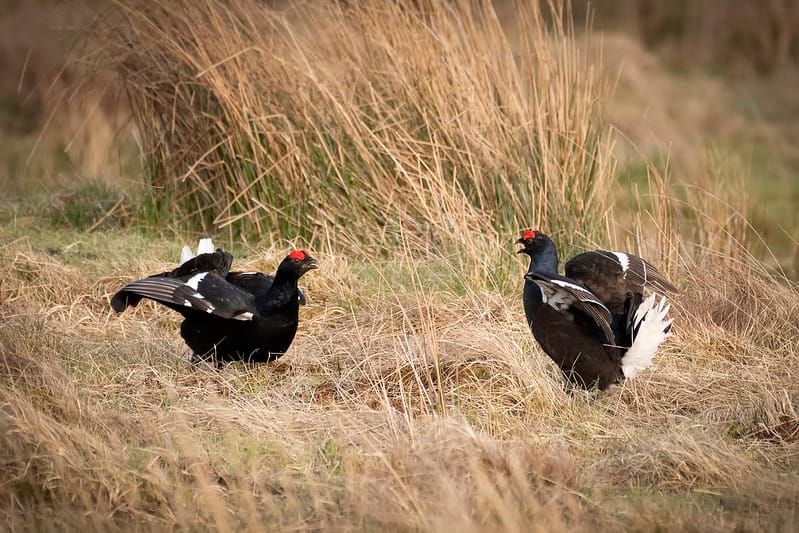
North York Moors | Black grouse chicks have successfully fledged on the North York Moors for the first time in almost 200 years, to the delight of conservationists. The ground-nesting bird, which is a red list species of high conservation concern, has been missing from the moors since the 1840s. To remedy this, a project led by the Game and Wildlife Conservation Trust restored areas of habitat before relocating twenty grouse from the Northern Pennines, the species’ last stronghold in England. By the end of the summer, four females had fledged 12 chicks. Another 20 birds will be released this autumn, with the aim of establishing a self-sustaining population. The Times reported the story.
Dartmoor | Incidents of ‘fly camping’ have increased by 60% on Dartmoor since the Supreme Court upheld the legal right to wild camp, reports the Times. The incidents range from pitching tents on roadsides with open fires, BBQs and generators to leaving sleeping bags, rubbish and even human faeces on the moorland. Officials at the Dartmoor National Park Authority said news headlines about the court case, combined with hot weather and social media posts, had caused incidents to jump from 160 in 2024 to 260 this summer. Next year, the authority plans to enlist the help of influencers to educate their followers about the camping code of conduct instead. The Independent also covered the news.
Carmarthenshire | The Wildlife Trust of South and West Wales has launched a campaign against proposals for an energy park which could threaten one of the last red squirrel strongholds in Wales. Once common in forests, there are now only three Welsh populations of reds left. The proposal, by renewable energy firm Galileo Empower, includes both solar and wind technology, and would border the Bryn Arau Duon Forest, where conservationists have been working to protect the red squirrel population for more than 20 years. The Trust said that tree clearance would destroy and fragment the habitat, while disturbance from construction would force reds into the wider area, making them vulnerable to squirrel pox virus. A public consultation is open until October. The BBC reported the news.
Elsewhere:
- Havant Borough Council has saved the nests of gulls and terns from flooding by raising lagoon islands in Langstone Harbour, reports the BBC.
- Lindisfarne Nature Reserve has launched a conservation hub to boost research on climate adaptation and marine ecology, reports the BBC.
- Seagrass seed planted earlier this year by the Hampshire Wildlife Trust has taken root and is flourishing in the River Hamble for the first time in almost 100 years.
- Cornwall Wildlife Trust has started work on its project to restore temperate rainforest habitat at West Muchlarnick near Looe.
- A report by the Clean Earth Trust found that plastic makes up 82% of the litter on Guernsey beaches, reports the Guernsey Press and BBC.
- A research centre in Norwich is recruiting 76 people to test the impact of gene-edited tomatoes, in what is thought to be the first human trial in the UK, reports the BBC.
- Natural England has opened a 26 mile stretch of coastal path along the Deben Estuary, providing access to some of Suffolk’s remaining saltmarsh landscapes, reports the BBC.
- Police Scotland has found a banned pesticide in the body of a red kite discovered dead in Perth and Kinross, report the Herald and BBC.
- The Wildlife Trust for Manchester has conducted its first harvest of bulrush heads on its wetter farming trial site at Chat Moss.
- The Scottish government has passed a byelaw banning campfires and barbecues in the Cairngorms National Park during summer, reports the Herald and Scotsman.
Reports
Trees | Around 2.5 million more trees are needed in towns and cities across Scotland to create ‘tree equality’, according to a report by the Woodland Trust. This refers to the need for ‘full and fair access’ to urban trees and the benefits they provide. Using its tree equity mapping tool, the charity identified more than 40,000 hectares with high social deprivation and low tree cover. It also revealed that Scotland’s wealthiest urban areas contain double the tree cover of its poorest, while healthier neighbourhoods on average boast 40% more trees than the least healthy ones. The charity said it would prioritise planting in high need areas over the next five years, but that planting all 2.5m trees is a long-term goal which it would not be able to deliver alone. The BBC covered the research.
London | The London Assembly has published a report calling on mayor Sadiq Khan to set ambitious targets to clean up the capital’s rivers. In his 2024 manifesto, Khan promised to make London rivers swimmable within ten years, and the report outlines 12 key recommendations to achieve this. These include designating four new bathing water sites by 2028 and a further six by 2034: these should be distributed across the capital and start with locations already used for recreation. The report also calls for action to reduce sewage pollution and road run-off. Zack Polanski, committee chair and new Green Party leader, said that ‘a wealthy city should not be embarrassed as London is by sewage in rivers’. The BBC covered the news.
Community | A report by the Tree Council and Forest Research examines the impact of the UK’s community tree nurseries (CTN) for the first time. These are nurseries which are small in scale, largely run by volunteers, and reliant on grant funding. The research project mapped a network of approximately 80 CTNs across the country. It found that these nurseries are responsible for producing around 250,000 trees each year, most of which are native species and many grown from seeds collected locally. They also encourage a raft of social benefits, including inclusive community spaces and connection to nature. The report concludes that CTNs have an outsized impact on both environmental and social goals – particularly given their limited funding – and calls for targeted support for financial stability and training.
Science
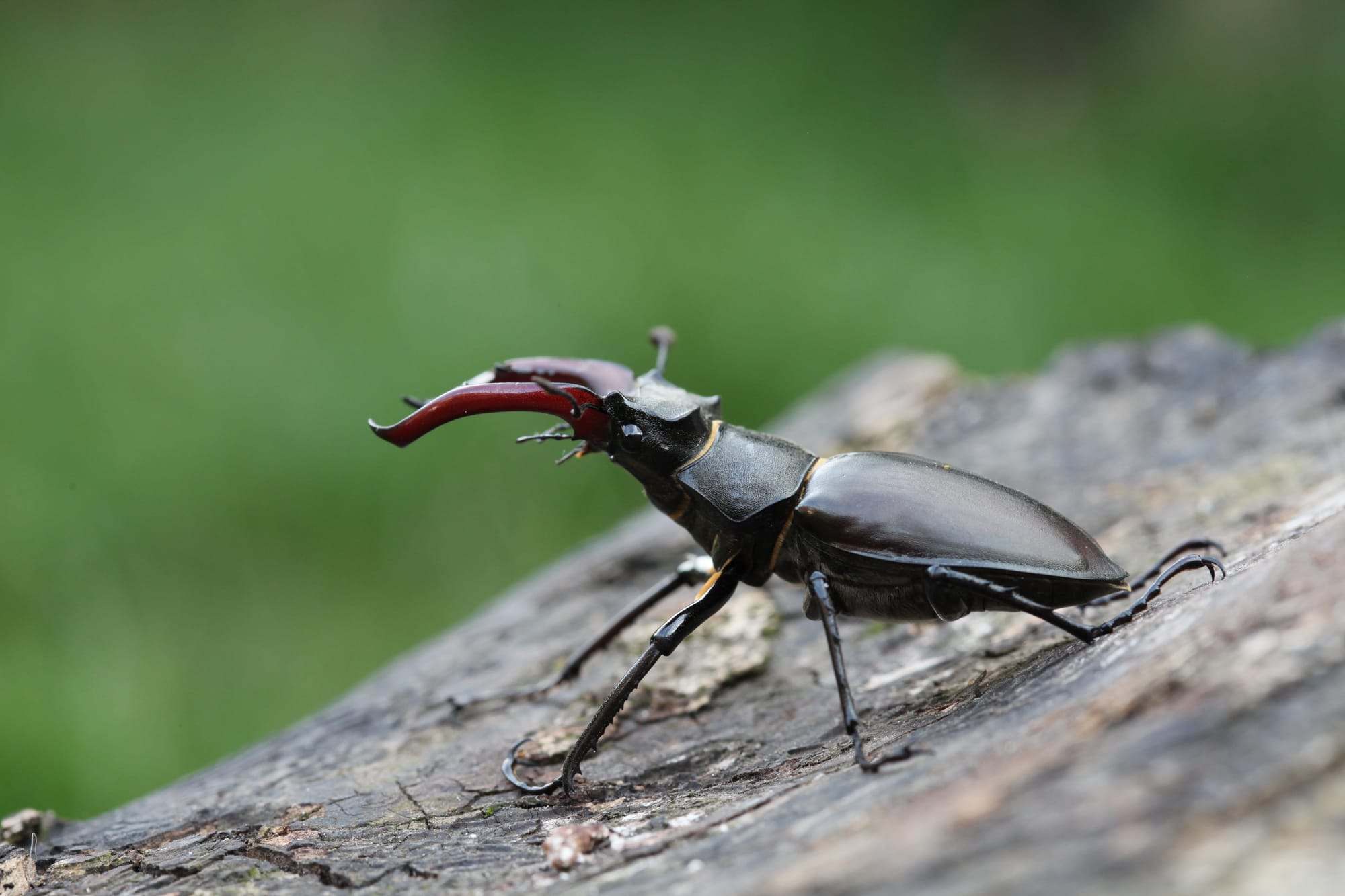
Beetles | Britain’s population of stag beetles, the largest beetle species in Europe, is relatively stable, according to the first national analysis of its distribution. Scientists analysed 82,883 records collected by citizen scientists as part of the ‘Great Stag Hunt’, run by the People’s Trust for Endangered Species since 1998. The results describe a broadly stable distribution over the last 25 years – and across museum records going back a century – although with a slight decrease within its western range more recently. The data also indicates that fewer adult stag beetles are being spotted together in one location, leading the authors to warn that there is ‘no room for complacency’. The study was published in Insect Conservation in Diversity.
Wolves | The European Parliament’s decision to downgrade wolves from ‘strictly protected’ to ‘protected’ highlights the need for more adaptive conservation policies, according to a study in Conservation Letters. The historic vote reflected the remarkable recovery of Europe’s wolf population, yet the downlisting has been fiercely criticised by conservationists. In the paper, the authors argue that, as large carnivore populations grow, conservation policies must move beyond a ‘crisis narrative’ designed for species on the brink of extinction. Instead, decision-makers should seek to foster coexistence. Co-author Erica Von Essen explained: ‘We need new stories and visions… ones which do not hinge on them cleaning up our ecological mess for us, and which are not solely authored by conservationists.’
Crabs | Female crabs are attracted to the electromagnetic fields from underwater cables, which could disrupt their natural rhythms and behaviours, according to a study by the University of Portsmouth. Researchers conducted a lab-based experiment, exposing 120 crabs to varying levels of electromagnetic fields, similar to those in the cables used by offshore wind farms. They found that female crabs spent almost twice as long in electromagnetic zones, while male crabs showed no preference. The authors say this attraction could disrupt key reproductive behaviours like seasonal migrations and the laying of eggs, with knock-on effects on population levels. The BBC covered the research, which was published in Environmental Science and Technology Letters.
Driftwood
Smell | During the Covid-19 pandemic, many of those affected abruptly lost their sense of smell – and quickly realised how much the olfactory sense underpins daily life. A feature in Atmos looks at how climate change could dispossess places of their defining scents.. The IPCC has warned that the next decade could see crops such as cocoa and coffee decline up to 50% in key regions. As journalist Omnia Saed writes: ‘To lose them would strip the fields of scent, and with it, a remarkable sense of self and place.’ The loss of smells would impact the more-than-human world, too, with a wide variety of species heavily reliant on scent to find food, shelter, mates and more. From pollinators to perfumers, ‘vanishing scents mean vanishing livelihoods and the cultures built around them,’ Saed writes.
Stiles | In Country Life, writer Harry Pearson pens an ode to the oft-overlooked country stile. The humble stile is a unique feature of the British countryside, according to Pearson, with a rich history. The name derives from the German stighel, meaning to climb or clamber, but their presence in Britain can be dated back to Anglo-Saxon times, even making an appearance in the works of Chaucer. They come in as many variations as there are British accents, each with its own quirks: the coffin stile allowed pallbearers into churchyards while keeping livestock out, for example, while the ‘clapper’ from Cambridgeshire looks more like a medieval siege engine. Today, many stiles are being replaced to make the countryside more accessible; while Pearson admits this makes practical sense, he admits a ‘wistful pang’ at the loss of their character.
Biobanks | As species become increasingly endangered, scientists are working against time to preserve their genetic material – but how do you choose which species to prioritise? In the Conversation, PhD student James Edward Brereton outlines recent research into the selection process for wildlife ‘biobanks’. These are essentially scientific freezers, running at -196°C, which store animal cells. The research revealed that selection for biobanking often contains biases such as favouring mammals – reflecting the bias in conservation efforts globally – as well as species which are local. The researchers conclude that a unified biobanking plan is needed so that biases and a lack of strategy does not shape ‘which species we see in the future – and which we lose.’
Further reading:
- A feature in the Times explores why rock’n’rollers are currently ‘digging’ soil science.
- In the Telegraph, read about the US billionaire facing heavy criticism over plans to host a super-sized pheasant shoot on his Wiltshire estate.
- The Guardian covers recent progress made by a project to ‘resurrect’ Ice Age ghost ponds.
- A feature in the Times spotlights the environmentally-friendly designs on show at the London Fashion Week. Meanwhile, an article in Vogue asks whether nature finance needs a better publicist.
- A feature in Positive News profiles the grassroots growers, such as the LION initiative in London, reclaiming space through community gardens.
- An essay in Atmos asks whether tourism can help save the places and ecosystems it also endangers.
- In the Spectator, journalist Matthew Wilcox argues that rewilders fundamentally misunderstand the impact of rewilding the British countryside.
- An editorial in County Life questions whether bats are truly to blame for Labour’s house-building troubles.
- The Telegraph has three separate articles criticising rewilding this week: two on the apparent increased wildfire risk, and one on the threat to Britain’s grouse moors.
Happy days
Forests | The art magazine Colossal has a feature on photographer Frédéric Demeuse’s ongoing series, Forgotten Places. In these ethereal photos, Demeuse documents increasingly rare and remote pockets of ancient woodland. His aim is to create a visual record of these landscapes, and to connect with a primordial sense of wonder at nature. He says that focusing on deceptively simple views of the trees is a means to ‘inspire respect for the extraordinary complexity of the living world and remind us to stay humble.’ You can find more of Demeuse’s work on his website.
Subscribe to our newsletter
Members receive our premium weekly digest of nature news from across Britain.
Comments
Sign in or become a Inkcap Journal member to join the conversation.
Just enter your email below to get a log in link.