
Welcome to Continental Drift, where we explore the most interesting ecological research from across Europe.
In this edition, we take a deep dive into new research into coexistence between humans and wolves, including how society can help farmers to deal with inevitable losses. Have an opinion? Please leave a comment at the bottom.
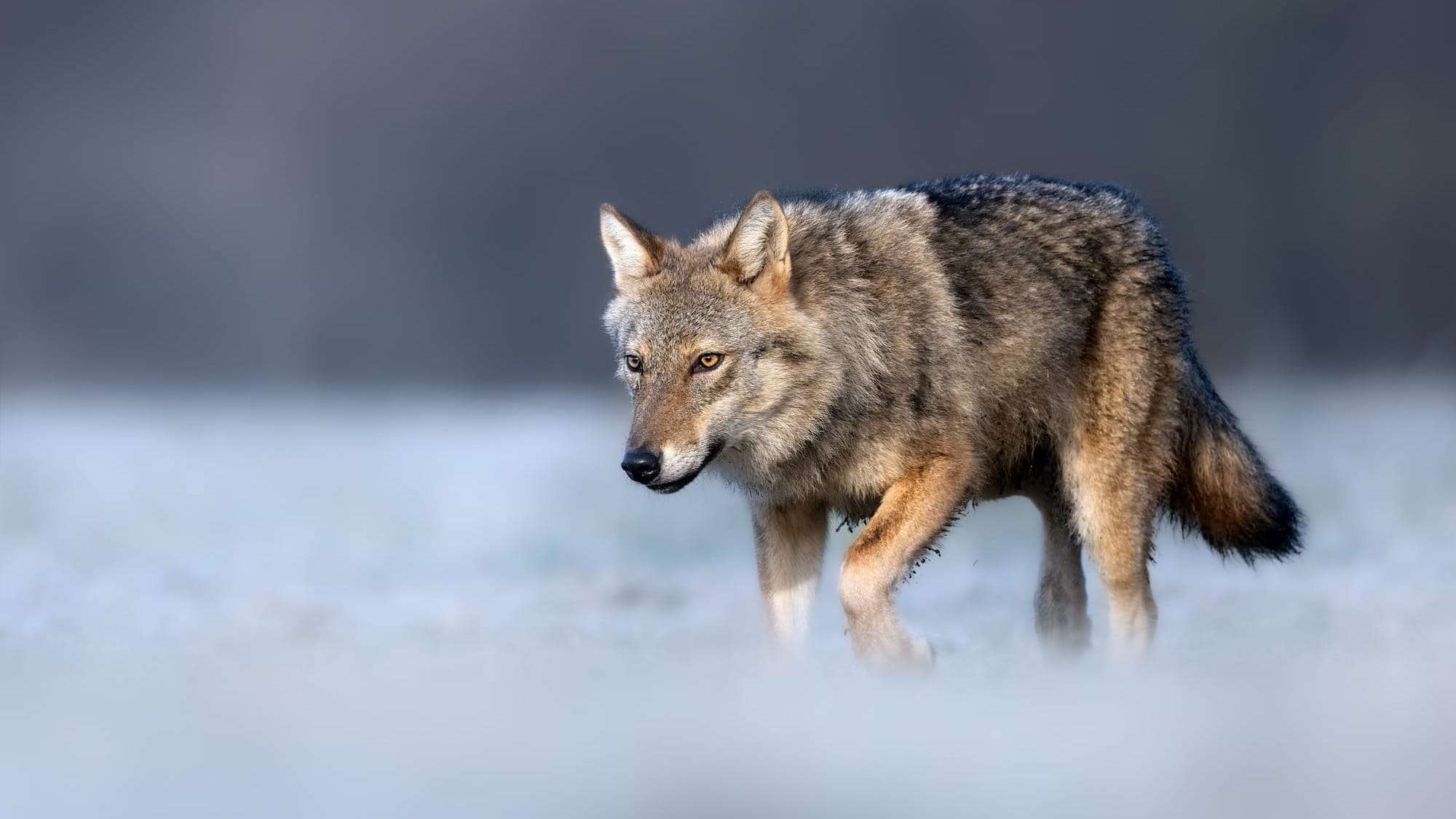
Wolves are expanding across Europe. Having been hunted to near-extinction in the 19th and 20th centuries, populations are now rebounding: there were, at the last count, some 21,500 individuals roaming across the continent.
The return of the wolf is a conservation success story. But it has also led to conflict with human communities, who are relearning what it means to live alongside them. In this edition of Continental Drift, we explore new research from places where coexistence is already happening, harmoniously and not, and what it means for the future of the wolf.
The first study focuses on lowland Germany. The location offers a valuable perspective. Most research on human-wolf relationships focuses on remote or mountainous landscapes. Here, however, there is nowhere to hide: the terrain is flat, fragmented by roads, and densely populated.
Here, researchers focused not on how humans are adapting to wolves, but how wolves are adapting to us. Have they become used to the presence of humans – or have they learned how to avoid us?
Familiarity breeds problems. Wolves may feel comfortable in our presence, but most people don’t feel comfortable in theirs: the sight of a predator in a town or city still elicits fear. Even the most benign encounter can lead to concerns that wolves are losing their wildness, explains Ilka Reinhardt, the lead author of the study.
‘There are many people who are happy if they see a wolf, but there are probably as many people that are not as happy,’ said Reinhardt. She cites the example of a wolf on a roadside: many would say that the wolf should not be there, or that it should run away. ‘The perspective is different towards different species.’
But are wolves actually losing their fear of people, or is this just our perception? To find out, researchers tracked 18 wolves for ten years, using GPS collars, to see how and when they were actually using the landscape.
Their findings, published in Wildlife Biology, reveal that wolves are not attempting to infiltrate our towns and villages. Rather, they are doing their best to stay out of our way.
Data showed that the wolves became increasingly nocturnal as human presence intensified. They largely stuck to scrubland, where the cover was thickest. There wasn’t a single instance of a wolf entering an urban settlement in daytime.
Yet wolves are sometimes spotted by roadsides – what about these individuals?
Even for the wariest wolf, these networks can’t be avoided. Germany has almost two kilometres of road for every square kilometre of land: wolves will necessarily encounter some tarmac as they move between habitats. Similarly, although wolves sometimes used open landscapes, these visits took place in darkness and never lasted long.
This is a positive finding for the return of the wolf. It shows that humans and wolves can thrive alongside each other – not by learning to get along, but by staying out of each other’s way.
If coexistence is possible here, then could it be possible in Britain, too? Germany has a similar population density to the UK.
‘If you look at the human point of view, you can say it is possible to have large carnivores even in a cultivated landscape: if they can live in Germany, we would expect they would adapt in a similar way to the UK,’ said Reinhardt.
‘What is probably much more of a conflict point in the UK is the way of sheep husbandry. If you have unprotected sheep and a large carnivore, then you will have huge conflicts on that side. This is manageable, of course – we know how sheep can be protected – but it would mean a complete change of the husbandry system.
‘But just from the human point of view, we have reinforced this knowledge that, even in a strongly human dominated landscape, they are able to adapt in a way that makes land sharing possible.’
But who really bears the burden?
The question of sheep farming, however, is one that cannot be avoided – especially in a place like the UK, which has roughly 30 million sheep.