Welcome to Ground Cover, our roundup of news, science reports and features. Here’s what you’ll find in this week’s edition:
- National: Election demands, Treasury inquiry, ash dieback.
- Local: Glyphosate debate, oyster reintroduction, football.
- Reports: SSSI failure, National Parks, missing chickens.
- Science: Bison microbiome, chalk stream salmon, perch genetics.
- Driftwood: Obama, Plant Baby Plant, deer hunting.
National news
Elections | As the May elections creep closer, nature charities are setting out their stall. Coed Cadw, the Woodland Trust in Wales, has published Rooted Together, its manifesto for a ‘healthier, fairer and more resilient Wales’. It makes four demands of the Senedd: prioritise tree equity, fund nature-friendly farming, protect and restore ancient woodlands and veteran trees, and back the nature-based economy. Wales247 covered the story. The RSPB has also set out its priorities for the UK’s newly elected representatives. In Scotland, demands include strong nature targets and more funding for the Nature Restoration Fund. Ambitious restoration targets are also a focus in Wales. In England, where elections will determine the makeup of local councils, key demands include reducing grass cutting, shunning pesticides and creating nature corridors.
Inquiry | The cross-party Environmental Audit Committee has launched an inquiry into the role of the Treasury in shaping wider government decisionmaking on nature, climate and the environment. Specifically, it will consider whether its fiscal rules constrain environmental policy, and whether it recognises the role of climate and sustainability in reducing economic risks and contributing to growth in the UK: see the call for evidence for a more extensive list of questions that will be considered. Toby Perkins MP, chair of the committee, said it was a vital opportunity to ‘hold Treasury ministers to account for their enormous influence on the future of our precious environment.’ Beccy Speight, CEO of the RSPB, said the inquiry was ‘exactly the kind of action needed to help reset the record on nature and to fully recognise the scale of the opportunity that investing in nature is for the UK.’
Ash | Scientists have offered fresh hope for the future of ash trees in Britain after developing a fast-track breeding method. Ash dieback, a deadly fungal disease, has devastated ash woodlands since it was confirmed in Britain in 2012. However, researchers at the John Innes Centre in Norwich have now developed a method of breeding disease-resistant ash which slashes the germination time of seeds from years to just seven days. The breakthrough involves extracting the plant embryo from the seed’s outer casing and accelerating its growth using nutrient-rich agar jelly. The team has already produced more than 2,000 seedlings for trials, seed orchards and planting schemes, and is currently working on a ‘kitchen table’ version so that volunteers and gardeners can cultivate seedlings at home. The Times and Forestry Journal covered the news, with further commentary in this Times editorial.

In other news:
- The Welsh Affairs Committee is calling on the government to tackle the environmental and economic legacies of Wales’ industrial past. Read their letter here.
- King Charles has been awarded a Blue Peter Green badge for his ‘amazing’ work on the environment, reports the BBC.
- Conservationists are calling for restrictions on pet flea treatments after research found widespread contamination of songbird feathers, reports the Guardian.
- Research by the Church Commissioners shows that 56% of tenants are adopting regenerative practices, reports the Farmers Guardian.
Across the country
Cornwall | Councillors in Cornwall have voted to pause the reintroduction of a controversial weedkiller until a ‘meaningful public consultation’ has taken place. The chemical glyphosate has not been used by the council for a decade due to its toxicity, but it recently announced plans to use a diluted and targeted form to maintain highways and footpaths from next month. It gave town and parish councils only three weeks to decide whether to opt out and take on maintenance themselves. The move prompted widespread opposition, including from the local Wildlife Trust, a letter from 200 healthcare professionals, and two petitions signed by more than 1,000 people, citing the threat to both environmental and human health. On Tuesday, with around 100 protestors outside, councillors in Truro voted 61 to 7 in favour of pausing the plans. The story was widely covered in both local and national outlets.
Orkney | More than 15 million oysters will be released into the North Sea around Orkney in one of the largest marine rewilding projects in UK waters to date, reports the Guardian. The scheme will use a novel rearing process in an effort to reverse the dramatic decline of the UK’s oyster beds since the Industrial Revolution, driven by overfishing, pollution, climate change and deliberate clearance. Conservationists hope the project will provide a ‘blueprint’ for wider oyster-bed restoration around the British coastline, helping to restore marine ecosystems, improve water quality and sequester carbon. ‘It won’t just benefit fish and the bay, it will benefit sea mammals, seabirds and the whole environment,’ said Richard Land, the marine expert leading the project.
Brentford | On World Earth Day on Wednesday, Brentford FC launched the club’s first nature strategy, becoming only the second Premier League side to join the UN-backed Sports for Nature Framework. The strategy highlights the links between sport and its environment, stating that football ‘does not exist in isolation from nature. Every match is played on a living surface, shaped by soil, water, weather and biodiversity.’ With this in mind, the report outlines how the club plans to boost local biodiversity: proposed activities include installing wildlife habitats such as bespoke bee panels and bat boxes, creating a new community garden, and planting trees to act as artificial light buffers around pitches. The club will also draw on expert advice from Kew Gardens and conduct annual ‘nature audits’ to chart its progress. The BBC covered the story.
Elsewhere:
- The charity Initiative Earth is creating a 14-mile green corridor through east London’s most nature-deprived communities, reports the BBC.
- Devon Wildlife Trust has planted 17,000 native trees and shrubs to create rainforest habitat near Totnes.
- A farmer has discovered a new sub-site for one of Wales’ rarest winter plants, the three-lobed water crowfoot, on Gower, Swansea.
- Kent Police are investigating a ‘devastating’ fire at a protected nesting site in Ramsgate as arson, reports the BBC.
- A river in Denbighshire has changed course dramatically in recent years, potentially due to unauthorised modifications, reports Wales Online.
- A 20-year landscape recovery project is underway in Duddon Valley, Cumbria, combining nature recovery with fell farming, reports the BBC.
- A former horticultural nursery in Regent’s Park has been transformed into a biodiverse garden and will open to the public next week, reports the Guardian.
- The government has approved a ban on trawling and scalloping in the Beachy Head conservation zone off the Sussex coast, reports the Oceanographic and BBC.
- Rare white-letter hairstreak butterflies have been spotted after volunteers planted 430 disease-resistant elm trees on the Quantock Hills in Somerset, reports the BBC.
- Wildlife groups including Buglife are outraged by the continued destruction of fragile dune habitat on the Ardeer Peninsula, despite its potential designation as an SSSI.
- Next week, water company United Utilities will begin a 12-month trial using two buoys to constantly monitor water quality in Lake Windermere, reports the BBC.
- Conservationists used jam jars and hummus pots to breed one of the UK’s rarest flies, the pine hoverfly, and release 30,000 in the Cairngorms, reports the BBC.
- Rewilding charity Tir Natur has raised £100,000 in just two months of fundraising towards its rewilding project in Ceredigion’s Elenydd, reports the Cambrian News.
- Community organisations in Leeds have created bug hotels for a train station, each designed to look like a local landmark, reports the BBC.
- A project on the Smithills Estate near Bolton is trialling a new approach to creating woodland, combining seed scattering with cattle grazing, reports the Bolton News.
- The UK’s first heathland green bridge is due to open over the A3 in Surrey next month, reports the BBC.
- North Yorkshire Council has thrown out plans to expand a water bottling facility into a community woodland following a campaign by hundreds of residents, plus Dames Judi Dench and Joanna Lumley. The news was widely covered.
Reports
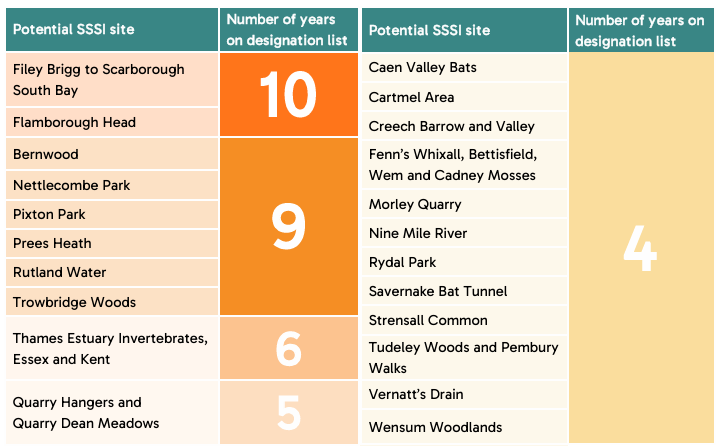
Protection | Natural England is failing in its duty to protect Sites of Special Scientific Interest (SSSIs), according to a report by campaign group Wild Justice. SSSI designation gives places with rare wildlife or habitats special protection within the planning system. However, Natural England has not designated a new SSSI since 2023, and since 2005 the total area of SSSIs has grown by just 2.8%. Researchers found that, of the 22 sites awaiting designation, one (in Thurrock) has already had a planning application approved on it, while a further 14 are at ‘high risk’ of damage from developments within 1km. Bob Elliot, chief executive of Wild Justice, said that the watchdog’s indecision ‘is not a technical failure, it’s a dereliction of duty’. The Guardian covered the research.
National Parks | Eighteen months ago, Defra promised to empower National Parks and Landscapes with new legislation to boost nature recovery and access to the outdoors (see our coverage here) but is yet to fulfil this commitment. Now, the Campaign for National Parks has published a report setting out recommendations for the government to modernise the parks’ governance system and unlock their full potential. The report is based on interviews with 33 people involved in NPA governance, and is split into ‘quick wins’ and longer-term legislative changes. The former includes changes to recruitment and training processes to support more people from diverse backgrounds to become Board members, while legislative changes include strengthening the statutory purposes of NPAs and giving nature a voice by appointing a dedicated representative.
You've read 50% of this week's newsletter. Behind the paywall: 25 million missing chickens, why scientists believe that chalk stream salmon should be a distinct subspecies, a new grassroots movement from Robin Wall Kimmerer, huge globes of lichen, and more. Subscribe to read.