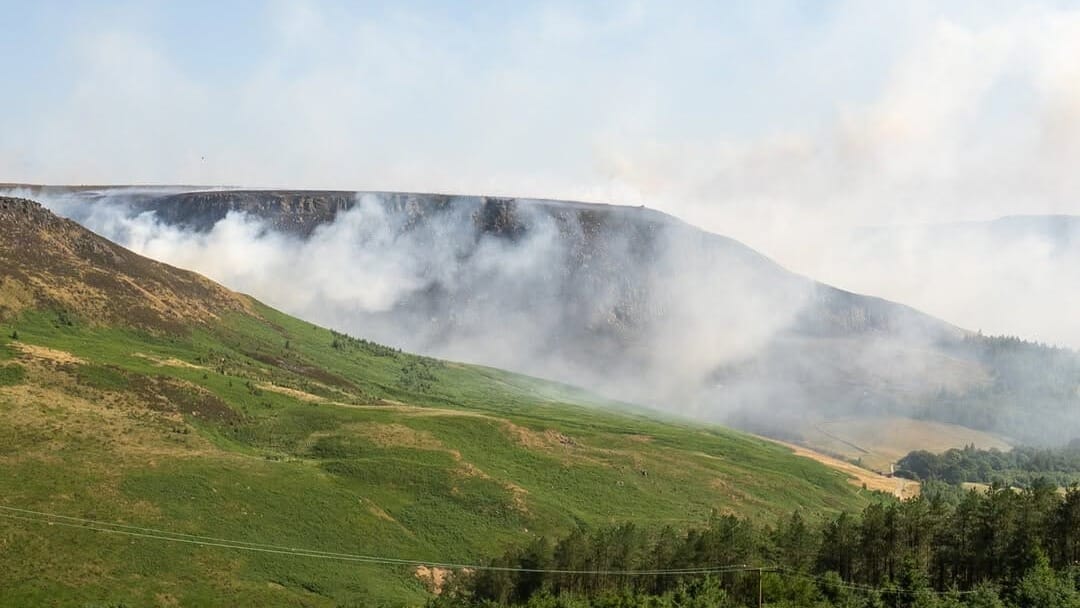
It's not often I find myself personally witnessing a story that makes it into this newsletter. This week is different. I was on my way to watch some Appalachian clog dancing among the apple trees of Old Durham Gardens. As we approached, we saw smoke. The neighbouring fields were on fire.
It used to feel like global warming was something that affected coastal communities, Arctic villages and coral reefs. Now it's on my doorstep, polluting the air my children breathe and threatening local displays of clog dancing (which still went ahead, thankfully). News of a Britain-wide firewave this week means there's a good chance it has arrived on your doorstep too.
This is no longer about hot summers days that the newspapers can illustrate with photographs of beaches and ice-cream. There can be no sugarcoating of a wildfire: this is disaster-level stuff. Climate change is personal to everyone now.
But this week's newsletter isn't all doom and gloom. We also cover:
- Dorset's first baby puffin in three decades
- The rewilding of Strawberry Hill
- The experience of being a grass snake
- How to get Londoners to rewild their gardens
Welcome, too, to the 100+ new people who joined us this week. Given the sudden surge in interest, we're offering 50% off all new subscriptions till 9PM today. Members receive this newsletter every Friday – click here to sneak past the paywall on last week's edition to see what you're missing.
National news
Fire | The UK is in the midst of a ‘firewave’, with more than 250 wildfires over the past two weeks due to tinderbox conditions. Homes in the Cairngorms were evacuated. Communities across Greater Manchester have been blanketed in smoke. Ancient woodland was destroyed in East Sussex and disposable BBQs found at the site of a blaze in the New Forest. Farmers called for more resources and government action as fires raged across North Wales. In Dorset and Durham, fields caught flame. A common in Surrey was left ‘crispy’. The number of blazes left authorities struggling to share limited helicopters. The Times spoke to fire experts and people affected by the blazes. The heatwave is also taking a wider environmental toll, with only 13% of English rivers at normal levels for this time of year, and wildlife such as bumblebees struggling to survive. The National Drought Group is ramping up efforts to protect water sources, and Natural Resources Wales has officially declared drought in North Wales and the Upper Severn. The Independent published before-and-after images showing the visual impacts of heat on the landscape.
Government | On Monday Andy Burnham officially became UK Prime Minister. He remained relatively tight-lipped on the environment and climate change during his leadership campaign – although CarbonBrief has unearthed 28 relatively promising quotes from the archive – so little is known about how he intends to reshape environmental policy. Media reports have suggested the new administration could allow more drilling in the North Sea, despite Burnham’s previous support for net zero. The charity Cool Earth also pointed out that Burnham’s introduction of a £2 bus-fare cap comes at the cost of international climate finance tackling issues such as deforestation. During his cabinet reshuffle, Burnham replaced environment secretary Emma Reynolds with Angela Eagle, who served as farming minister until last month. Eagle has pledged to focus on fixing the water system, backing Britain’s farmers and restoring nature. The changes come amid growing dissatisfaction, with recent WWF polling revealing that 57% of the public think Starmer’s government performed badly on nature. Read more reaction in Driftwood.
Shooting | Natural England has lost a High Court battle over the release of pheasants in protected areas. The British Association for Shooting and Conservation argued that the regulator had overstepped by preventing shooting estates from keeping gamebirds in pens in Special Protected Areas ahead of their release – a condition that was imposed to prevent the spread of bird flu. BASC said that this did not amount to a ‘release into the wild’ and that Natural England therefore had no authority to prevent it, and Mr Justice Ritchie agreed. Natural England plans to appeal the ruling, arguing that it imposed the conditions ‘for the purpose Parliament intended: protecting vulnerable species and ensuring compliance with wildlife conservation law.’ The Telegraph covered the story.
In other news:
- A new cross-party parliamentary group, with 13 MPs alongside Peers, has begun work on protecting England’s chalk streams.
- The ex-chief executive of Southern Water has been charged with fraud over plans to manipulate water quality tests, reports the BBC.
- NatureScot is aiming to publish a map of ancient woodlands and their conditions for the first time, with the final product going live in 2027, reports the Scotsman.
- The Welsh government has promised a new National Food Strategy, covering the ‘entire food system from farm to fork’. It also launched a consultation on a White Paper covering rural communities, climate change and environmental protections.
- Shark scientists have been granted nearly £1m by Natural England to study three endangered species, reports the BBC.
- The government has rejected the OEP’s call for an urban heat strategy on the grounds that it would duplicate existing measures, reports ENDS. The majority of its other recommendations were accepted.
- Natural Resources Wales has released its annual report, highlighting recovery to peatlands and certain species, as well as ongoing challenges and declines.
You're one-fifth of the way through this newsletter.
Why is NatureScot tagging sea eagles? How do 'smart forests' harm communities? What chemicals are inside our fish? Subscribe to find out.